



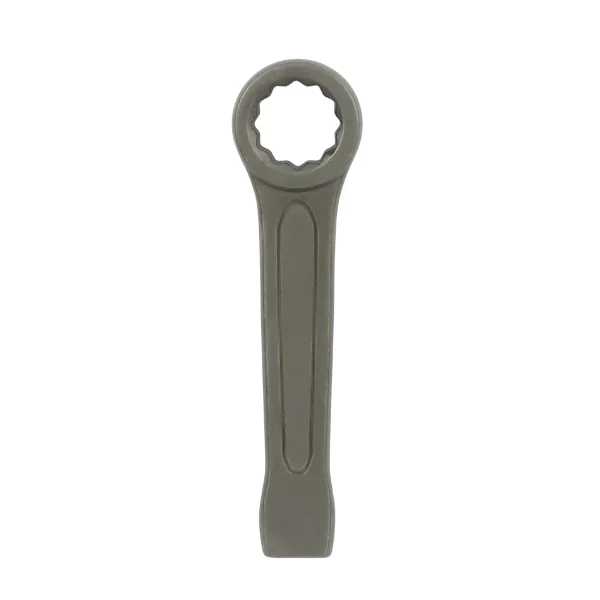
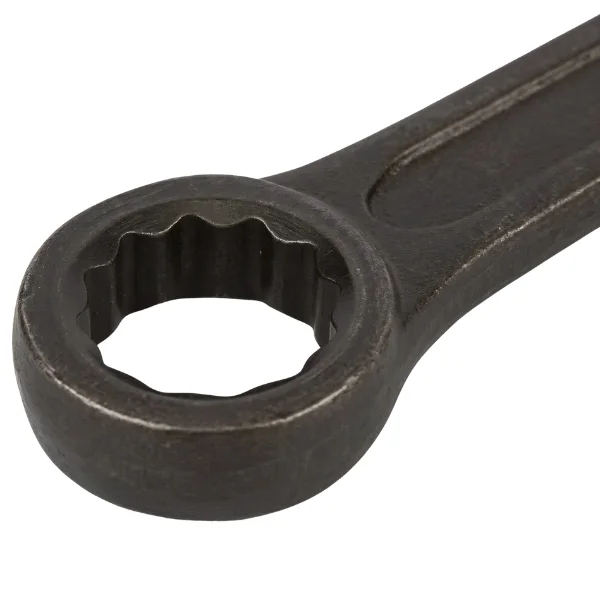
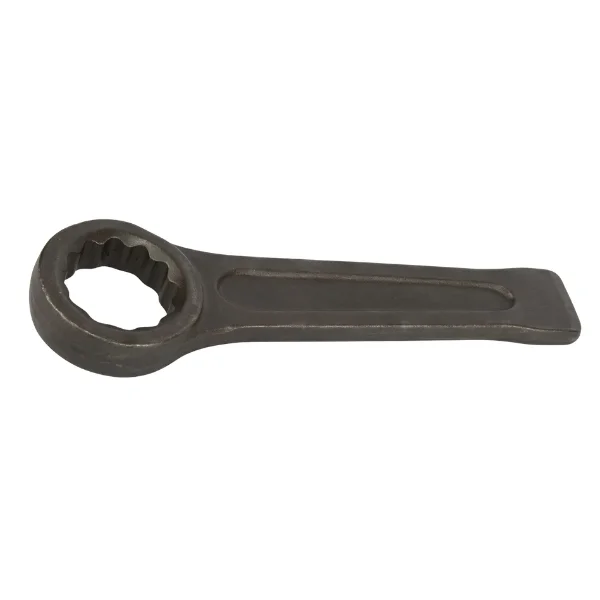
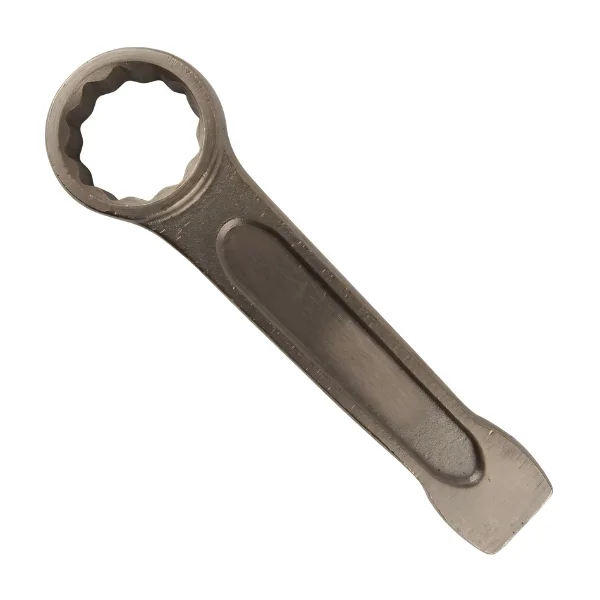


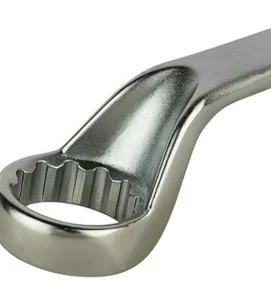
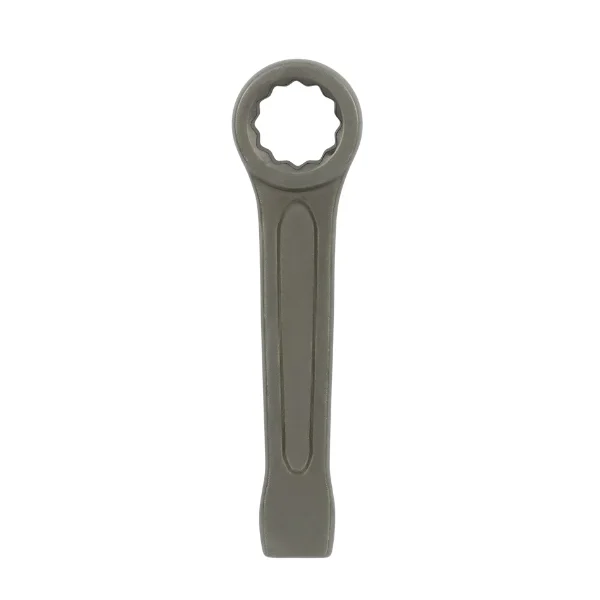
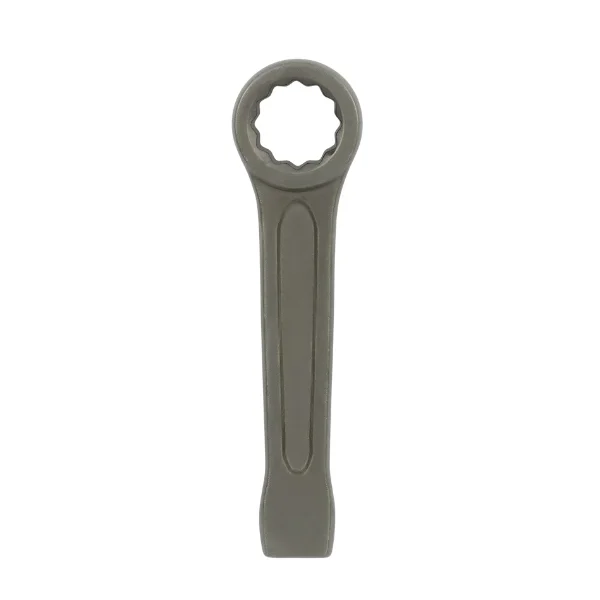
The ring end fully engages the fastener while the extended striking handle allows controlled hammer blows, making it suitable for high-torque industrial bolting applications.
Application Context & Use Cases
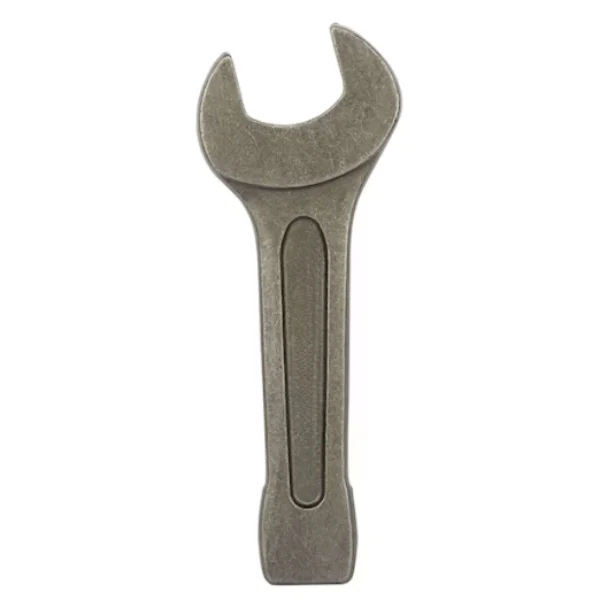
Large industrial fasteners often require torque levels that exceed the capability of conventional spanners or manual wrenches. In such cases, slogging spanners (also called striking wrenches) allow torque to be applied through repeated hammer strikes on the wrench handle.
Typical Industrial Applications
Heavy Maintenance Operations
Used where large nuts must be loosened after long service intervals.
Examples include:
Power plant turbine assembly bolts
Steel plant rolling mill fasteners
Cement kiln support structures
Mining equipment maintenance
Shipyard structural assembly
Shutdown Maintenance
During plant shutdowns, maintenance crews must remove large diameter fasteners quickly.
Typical situations:
Heat exchanger flange bolts
Structural anchor bolts
Industrial gearbox housings
Construction & Infrastructure Assembly
Heavy construction projects use large hex fasteners where torque multipliers are not available.
Examples:
Bridge structural joints
Heavy crane assembly
Rail infrastructure fasteners
The 90 mm size is typically used with very large industrial nuts, usually in heavy equipment and structural engineering applications.
Selection Guidance — How to Choose the Correct Slogging Spanner
Selecting the correct slogging spanner is primarily determined by fastener size and torque requirement.
Step 1 — Confirm Nut Size
Measure the across-flats dimension of the hex nut.
For this tool:
Required nut size = 90 mm
Using an incorrect size may result in:
Tool slippage
Fastener damage
Operator injury
Step 2 — Confirm Impact Method
This tool is designed for hammer-driven torque, not continuous rotation.
Suitable when:
High torque is required
Bolts are seized
Torque multipliers unavailable
Step 3 — Confirm Working Environment
Slogging spanners are appropriate for:
Open access bolts
Industrial maintenance areas
Heavy equipment structures
They are not suitable for confined spaces.
Capacity / Calculation Example
Torque Generation Principle
Torque is generated by impact energy delivered through hammer strikes.
Torque (T) depends on:
Hammer mass
Impact velocity
Spanner length
Example Scenario
Industrial fastener:
Nut size: 90 mm
Bolt type: structural heavy hex
Estimated torque requirement: 2500–4000 Nm
Maintenance procedure:
Ring spanner engages nut
Hammer strikes applied to handle
Impact force converts into rotational torque
This method allows incremental torque application when mechanical torque tools are unavailable.
Failure Conditions & Misuse Risks
Slogging spanners are designed for impact use, but misuse can cause tool failure.
Incorrect Hammer Selection
Using excessive hammer weight may cause:
Tool deformation
Handle damage
Partial Ring Engagement
If the ring is not fully seated:
Nut edges may round off
Tool may slip during strike
Incorrect Size Selection
Using a spanner larger than the nut leads to:
Poor contact area
High risk of slippage
Improvised Extensions
Adding pipes or leverage extensions is unsafe because:
Tool geometry is not designed for bending loads
Material / Compatibility Table
Fastener Compatibility
Typical Fastener Types
|
Fastener Type |
Compatibility |
|
Heavy hex nuts |
Suitable |
|
Structural bolts |
Suitable |
|
Anchor bolts |
Suitable |
|
Standard hex nuts |
Depends on size |
|
Flange bolts |
Depends on clearance |
Material Compatibility
Typical Industrial Materials
|
Material |
Compatibility |
|
Carbon steel fasteners |
Suitable |
|
Alloy steel fasteners |
Suitable |
|
Stainless steel fasteners |
Suitable |
|
High-strength structural bolts |
Suitable |
Operational Handling & Installation Considerations
Safe Operating Procedure
Proper handling improves both safety and efficiency.
Inspect tool for visible cracks
Confirm correct ring size
Fully seat the ring on the nut
Apply hammer strikes on the striking face
Maintain stable operator stance
Safety Considerations
Operators should use:
Safety gloves
Impact-rated hammer
Eye protection
Hammer striking generates metal impact shock, so workplace safety standards should be followed.
Commercial Clarity
Supply Scope
The following commercial details apply for industrial procurement.
Dispatch & Lead Time
Parameter |
Details |
|
Supply Type |
Industrial tool supply |
|
Dispatch capability |
Pan-India shipping |
|
Typical dispatch |
Based on stock availability |
Order Conditions
Parameter |
Details |
|
Minimum Order Quantity |
Single unit or bulk |
|
Bulk procurement |
Available |
|
Industrial billing |
GST invoice provided |
Compliance & Documentation
Parameter |
Details |
|
Manufacturer |
STANLEY |
|
Product identification |
Model STMT96973 |
|
Procurement suitability |
Industrial and contractor use |
|
Tender participation |
Supported with documentation |
Procurement Process — How to Enquire
Industrial buyers typically provide the following information during enquiry.
Required Procurement Details
Provide:
Product model (STMT96973)
Required quantity
Delivery location
Project or maintenance requirement
This enables accurate quotation and delivery planning.
Comparison Table — Common Alternatives
|
Tool Type |
Torque Method |
Suitable Nut Size |
Precision |
Typical Use |
|
Slogging spanner |
Hammer impact |
Large nuts |
Low |
Heavy maintenance |
|
Standard ring spanner |
Manual rotation |
Small–medium |
Moderate |
Mechanical repair |
|
Torque wrench |
Calibrated torque |
Medium |
High |
Precision assembly |
|
Hydraulic torque wrench |
Hydraulic torque |
Large bolts |
Very high |
Critical bolting |
Selection Checklist
Before purchasing a 90 mm slogging spanner, confirm the following:
Fastener size is 90 mm across flats
Hammer striking method is acceptable for the application
Adequate working space is available
Bolting does not require calibrated torque
Maintenance crew is trained in striking wrench use
If all conditions are satisfied, a 90 mm ring-end slogging spanner is an appropriate tool.
High-Intent FAQs
What size nut fits a 90 mm slogging spanner?
A 90 mm slogging spanner is designed for hexagonal nuts measuring 90 mm across flats.
Can this tool be used with a torque wrench?
No. Slogging spanners operate through hammer impact, not calibrated torque application.
What hammer size should be used with a slogging spanner?
Impact hammers used with slogging spanners typically range between 4–10 kg depending on torque requirement and operator control.
Is the STMT96973 suitable for high-strength bolts?
Yes. The tool is suitable for large industrial fasteners, including high-strength structural bolts.
When should a hydraulic torque wrench be used instead?
Hydraulic torque tools should be used when:
Precise torque values are required
Bolt preload is critical
Controlled tightening is necessary
Is this tool suitable for confined spaces?
No. Slogging spanners require swing space for hammer impact, making them unsuitable for restricted access areas.
Technical SpecificationsProduct Identification
Model Reference
|
Parameter |
Specification |
|
Manufacturer |
STANLEY |
|
Model Number |
STMT96973 |
|
Tool Type |
Ring-End Slogging Spanner |
|
Ring Size |
90 mm |
|
Use Method |
Hammer striking |
|
Application Category |
Heavy industrial bolting |
Dimensional & Construction Characteristics
General Tool Construction
|
Parameter |
Description |
|
Head Type |
Ring-end (closed loop) |
|
Drive Engagement |
Hexagonal fastener |
|
Impact Application |
Hammer striking on handle |
|
Manufacturing Method |
Drop forged construction |
|
Surface Finish |
Corrosion-resistant finish |
Operational Characteristics
Functional Characteristics
|
Parameter |
Operational Relevance |
|
Ring engagement |
Ensures full nut contact |
|
Impact handle |
Designed for hammer strikes |
|
Load distribution |
Reduces rounding of fasteners |
|
Torque generation |
Achieved through repeated impact |







Customer reviews