



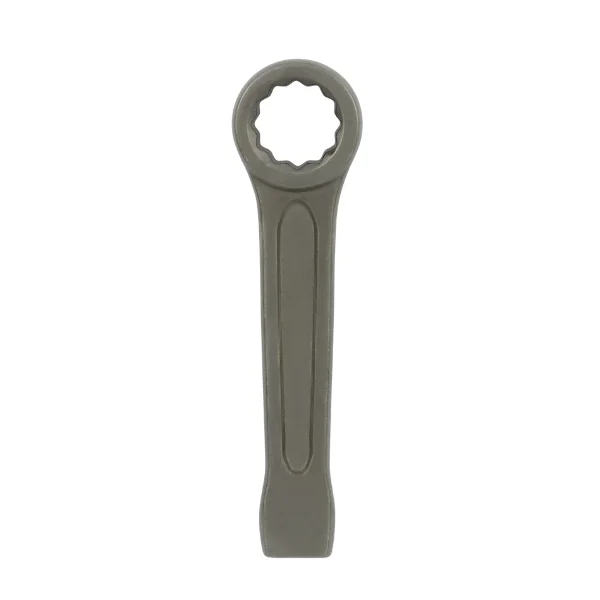
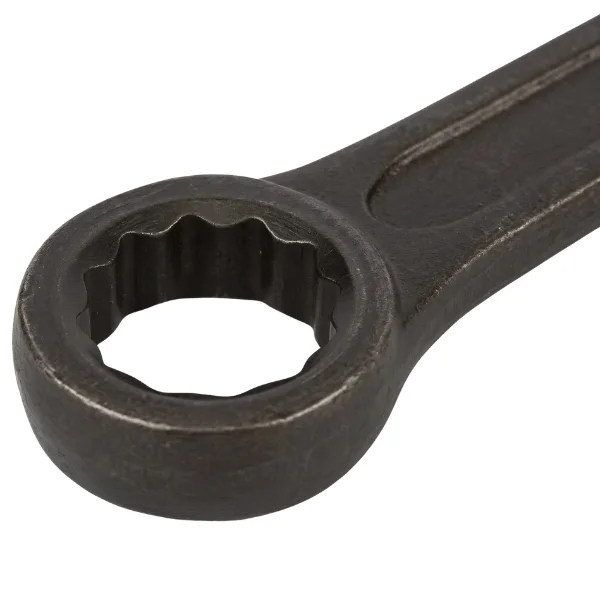
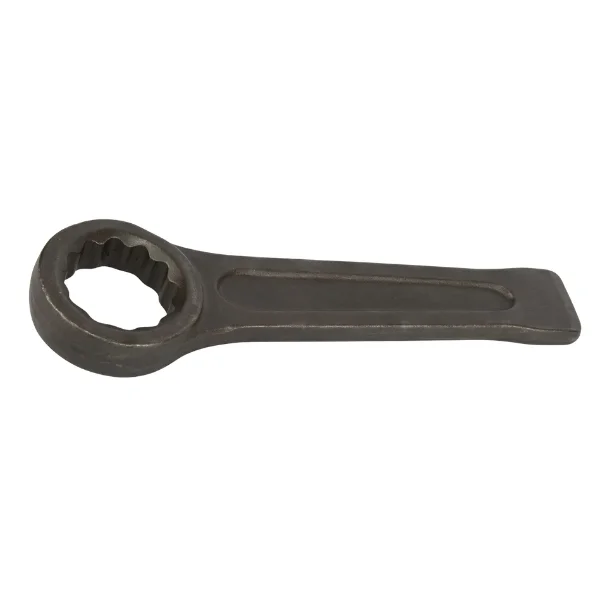
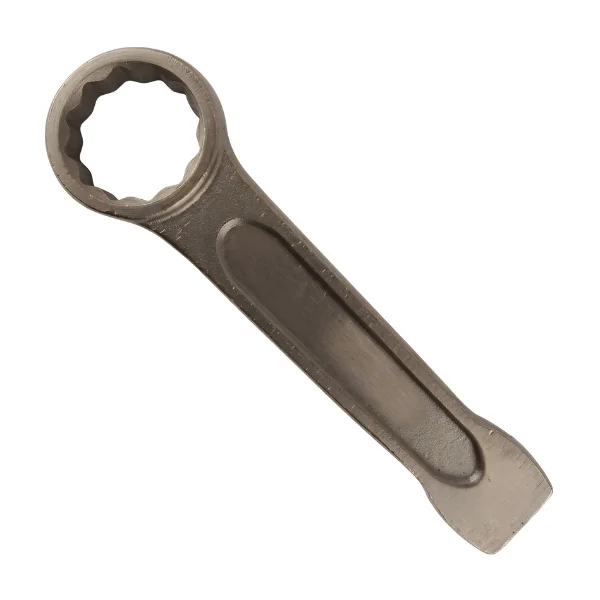


It features a reinforced ring end to distribute striking force evenly, making it suitable for high-torque maintenance work in steel plants, mining equipment servicing, refineries, and heavy engineering installations.
Application Context & Use Cases
Slogging spanners are used where conventional spanners cannot deliver the torque required to move large-diameter industrial fasteners. The ring-end design allows operators to apply torque through controlled hammer blows.
Typical Industrial Environments
• Steel plant equipment maintenance
• Mining machinery assembly and repair
• Cement plant kiln and crusher servicing
• Oil & gas pipeline flange maintenance
• Shipyard structural fastening
• Heavy engineering workshops
• Infrastructure equipment servicing
Typical Fastener Situations
High-Torque Industrial Bolts
Large flange bolts or structural bolts often require torque beyond manual leverage. A slogging spanner allows the required torque to be applied through hammer strikes.
Corroded or Seized Fasteners
Equipment exposed to heat, moisture, or chemicals often develops seized bolts. Hammer impact combined with ring-end grip helps break corrosion lock.
Limited Leverage Areas
Where pipe extensions or torque multipliers cannot be used due to space constraints, slogging spanners remain the practical tool.
Selection Guidance – Choosing the Correct Slogging Spanner
Selecting a slogging spanner should be based on fastener size, torque requirements, and working environment.
Step 1: Confirm Fastener Size
The spanner size must match the nut or bolt head size exactly.
Incorrect sizing causes:
• slipping
• edge rounding
• tool damage
For this model, the compatible fastener size is 110 mm hexagonal nuts or bolt heads.
Step 2: Evaluate Torque Requirement
Slogging spanners are used where torque requirements exceed manual leverage.
Typical scenarios include:
• Structural bolts
• heavy equipment anchor bolts
• large pipeline flanges
Step 3: Confirm Access Space
Ring-end slogging spanners require clear radial access for hammer striking.
If access is restricted, alternatives may include:
• Hydraulic torque tools
• slugging wrench variants
Step 4: Verify Hammer Compatibility
The tool must be used with industrial striking hammers capable of delivering consistent force.
Typical hammer range:
• 4 kg to 8 kg maintenance hammers.
Capacity & Torque Logic (Real-World Example)
To understand how slogging spanners generate torque, consider a typical maintenance scenario.
Example Case
A refinery maintenance team must loosen a 110 mm flange bolt on a pipeline assembly.
Tool Used:
STANLEY STMT96977 ring-end slogging spanner
Process:
Spanner ring engages bolt head.
Operator applies hammer strike to striking face.
Impact transfers torque through ring-end.
Torque Generation Logic
Torque = Force × Lever Distance
Hammer strike produces momentary high force, which translates into rotational torque through the spanner body.
Advantages of this method:
• High torque without long handles
• effective for seized bolts
• practical in restricted spaces
Failure Conditions & Misuse Risks
Improper use of slogging spanners can cause tool damage or safety hazards.
Common Failure Conditions
Incorrect Size Selection
Using an oversized spanner causes slipping and bolt head damage.
Excessive Hammer Force
Repeated excessive striking can damage tool structure.
Misaligned Hammer Strikes
Striking at angles may cause tool displacement or operator injury.
Using With Damaged Fasteners
Rounded bolts reduce ring engagement and increase slippage risk.
Safety Considerations
Operators should ensure:
• correct seating on fastener
• stable striking angle
• appropriate PPE usage
Material & Compatibility Table
The material compatibility determines where the tool can be safely used.
Fastener Material |
Compatibility |
Notes |
|
Carbon Steel |
Compatible |
Standard industrial use |
|
Alloy Steel |
Compatible |
High torque operations |
|
Stainless Steel |
Compatible |
Care required to avoid galling |
|
High-Temperature Fasteners |
Compatible |
Common in power plants |
|
Soft Metals |
Not recommended |
Risk of rounding edges |
Operational Handling Considerations
Proper Tool Seating
Ensure full ring engagement with the bolt head before striking.
Partial seating may cause:
• Tool slip
• fastener damage
Hammer Strike Direction
Hammer blows should be directed parallel to the spanner body axis.
Improper angles reduce torque efficiency.
Worksite Safety
Operators should maintain:
• Safe striking distance
• stable footing
• clear surrounding workspace
Commercial Clarity
Industrial buyers require clear procurement details before placing enquiries.
Lead Time
Lead time depends on:
• Stock availability
• order quantity
Most standard orders are dispatched based on available inventory.
Dispatch Capability
Pan-India dispatch available to:
• Industrial plants
• EPC project sites
• maintenance contractors
• distributor warehouses
Minimum Order Quantity (MOQ)
MOQ varies depending on:
• Procurement type
• distributor vs end-user purchase
Single-unit supply is typically possible for maintenance procurement.
Customization
Customization is generally not applicable because this is a standard branded industrial tool model.
Compliance & Certification
The tool is manufactured under the STANLEY industrial hand tool manufacturing standards applicable to forged hand tools.
Documentation availability depends on supplier distribution policies.
Tender Compatibility
The product may be referenced in tenders specifying:
• Brand name
• model number
• tool size
Tender supply capability depends on procurement documentation requirements.
Procurement Process
Industrial procurement teams should provide the following details when requesting supply.
Information Required for Enquiry
• Product model: STMT96977
• Tool size: 110 mm
• Required quantity
• Delivery location
• Urgency level
• Company name
Providing these details enables faster quotation and dispatch coordination.
Comparison Table — Common Alternatives
|
Tool Type |
Torque Capacity |
Application |
Advantages |
Limitations |
|
Ring-End Slogging Spanner |
High |
Industrial fasteners |
Strong grip |
Requires hammer access |
|
Open-End Slogging Spanner |
Moderate |
Limited clearance bolts |
Easier access |
Lower grip stability |
|
Hydraulic Torque Wrench |
Very High |
Critical bolts |
Precise torque |
Expensive equipment |
|
Long Lever Spanner |
Moderate |
General maintenance |
Simple use |
Limited torque |
The ring-end slogging spanner provides the best balance between torque capability and mechanical simplicity.
Selection Checklist
Before ordering a 110 mm slogging spanner, confirm the following:
• Fastener size is exactly 110 mm
• Application requires hammer-driven torque
• Worksite allows hammer striking clearance
• Bolt head condition is suitable for ring engagement
• Operators are trained for impact tool handling
• required quantity for maintenance work is confirmed
• Delivery location and timeline are known
Completing this checklist reduces procurement errors.
High-Intent FAQs
Is the STMT96977 suitable for high-torque industrial bolts?
Yes. The tool is designed for heavy-duty applications where hammer strikes are used to generate high torque for loosening or tightening large fasteners.
What industries commonly use 110 mm slogging spanners?
Industries include steel plants, mining operations, cement manufacturing, power generation facilities, shipyards, and large infrastructure maintenance environments.
Can the spanner be used for tightening as well as loosening?
Yes. Slogging spanners can be used in both directions depending on hammer strike orientation and fastener configuration.
Is this tool compatible with stainless steel bolts?
It can be used with stainless steel bolts, but care must be taken to prevent galling or surface damage during high-torque impact.
Does the tool require specialized training?
Operators should have experience with impact tools and hammer-driven maintenance equipment to ensure safe and efficient use.
Can a pipe extension be used instead of hammer strikes?
Pipe extensions are generally not recommended for slogging spanners. The tool is designed for hammer-driven torque rather than leverage extension.
Is the product suitable for field maintenance work?
Yes. Slogging spanners are commonly used in field maintenance environments where hydraulic or powered torque tools are not available.
The STMT96977 model is designed for heavy-duty industrial fastening environments where tool durability and dimensional accuracy are critical.
Technical Specifications
Core Product Data
|
Parameter |
Specification |
|
Brand |
STANLEY |
|
Model Number |
STMT96977 |
|
Tool Type |
Ring-End Slogging Spanner |
|
Size |
110 mm |
|
Construction |
Drop-forged alloy steel |
|
Finish |
Industrial corrosion-resistant finish |
|
Impact Application |
Hammer-driven torque |
|
Industrial Use |
Heavy equipment fastening |
Dimensional Data (Typical Industrial Reference)
|
Parameter |
Typical Range |
|
Jaw Size |
110 mm |
|
Length |
Heavy-duty industrial length profile |
|
Weight |
High-mass forging for impact resistance |
|
Ring End |
Reinforced circular ring |
Actual dimensions may vary slightly by production batch and manufacturing revision.







Customer reviews