



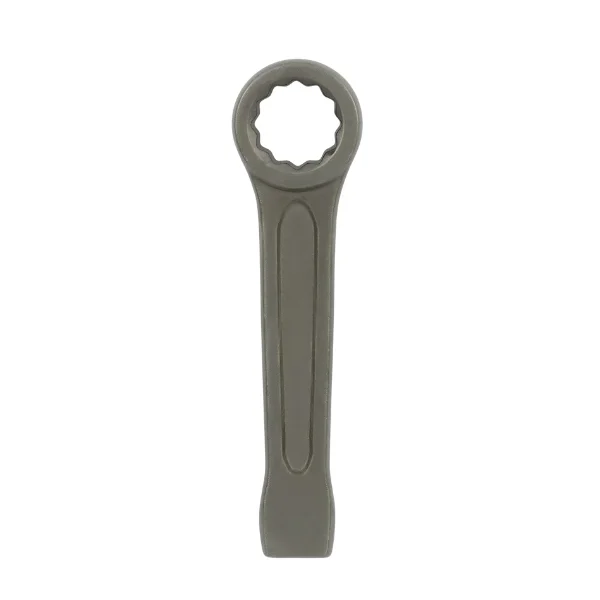
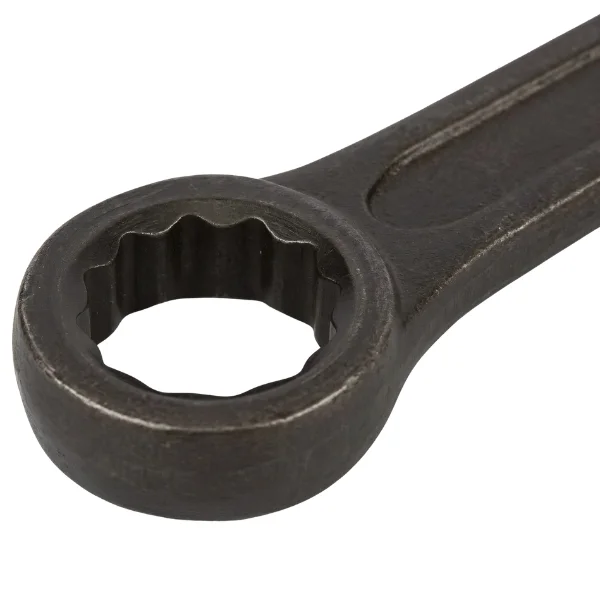
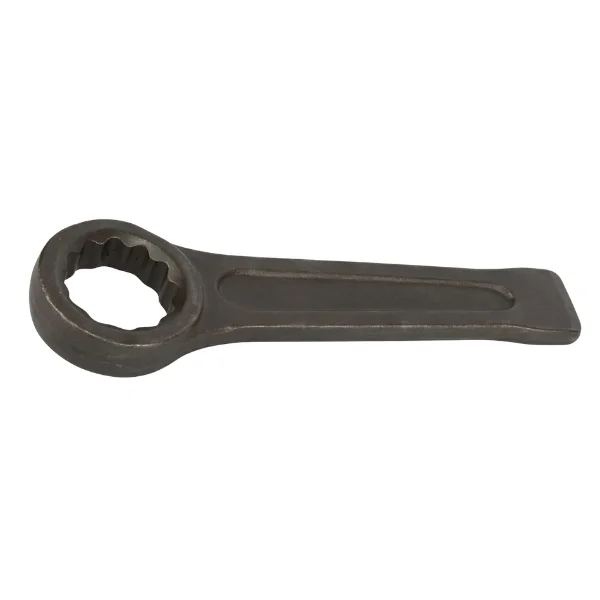
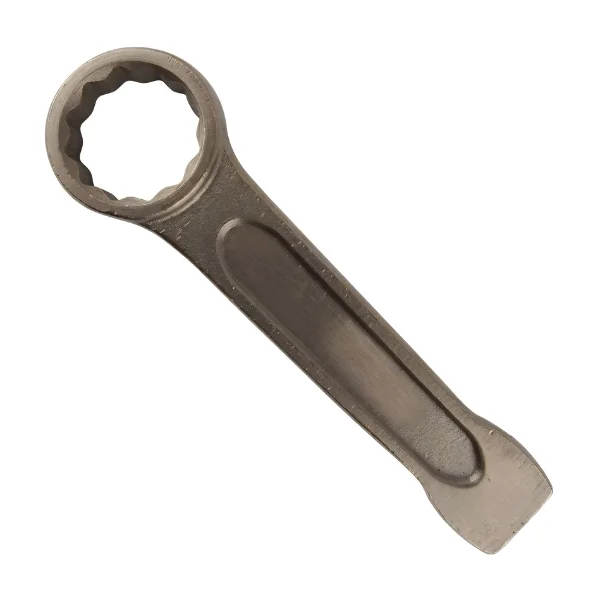


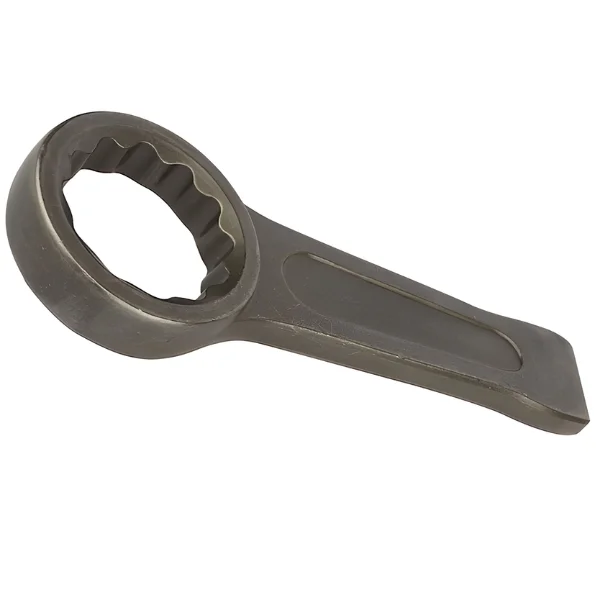
The ring end fully encloses the nut or bolt head, allowing controlled torque transfer under high loads commonly encountered in heavy industrial maintenance, plant shutdown operations, and large-diameter flange assemblies.
Application Context & Use Cases
Industrial slogging spanners are used where standard hand spanners cannot generate sufficient torque. Instead of continuous hand leverage, force is applied by striking the spanner with a hammer.
Common Industrial Applications
Power Generation Plants
Large flange bolts on steam pipelines, turbines, and pumps often exceed manual torque capability. Maintenance crews use slogging spanners during turbine servicing or pipeline dismantling.
Steel and Metallurgical Plants
Heavy equipment such as rolling mills, ladle systems, and furnace components involve large fasteners requiring impact-driven tightening.
Oil & Gas Facilities
Flange bolting in refineries and petrochemical plants frequently requires precise torque under constrained working spaces.
Mining and Cement Plants
Crushers, rotary kilns, and conveyor systems use heavy hex bolts that require controlled impact tightening during periodic maintenance.
EPC and Shutdown Contractors
Engineering contractors performing plant shutdowns require large-size slogging spanners like 70 mm for dismantling or assembling heavy equipment.
Selection Guidance
Selecting the correct slogging spanner depends primarily on fastener size, torque requirement, and working environment.
Key Selection Criteria
Fastener Head Size
The spanner size must match the exact hex dimension of the nut or bolt.
Example:
Fastener Head |
Required Spanner |
|
70 mm hex |
70 mm slogging spanner |
Using an incorrect size leads to:
Nut rounding
Slipping under hammer impact
Tool deformation.
Torque Requirement
Large fasteners used in structural equipment or heavy machinery require high torque levels.
Slogging spanners are chosen when:
Torque exceeds manual leverage capability
Hydraulic torque tools are not practical.
Access Constraints
In tight spaces, hammer striking allows torque application without requiring long handles or extension bars.
Impact Conditions
If the application involves repeated hammering, the tool must be designed to withstand repeated impact loads without cracking.
Capacity / Calculation Example
Real-World Torque Logic
When a hammer strikes a slogging spanner, the generated torque depends on:
Hammer weight
Strike velocity
Lever arm length of the spanner.
Example Scenario
Fastener: 70 mm hex bolt on pipeline flange
Typical field method:
Place ring end fully over bolt head.
Align spanner handle with striking direction.
Apply hammer blows to the striking end.
Torque generated increases as:
Hammer mass increases
Strike velocity increases
Lever length increases.
This method is commonly used during pipeline flange assembly or dismantling.
Failure Conditions & Misuse Risks
Incorrect use of slogging spanners can lead to tool failure or fastener damage.
Common Failure Scenarios
Incorrect Size Usage
Using a larger ring size causes:
Incomplete fastener contact
Slipping under impact
Rounding of bolt head.
Excessive Hammer Force
Applying extremely heavy hammer blows may cause:
Tool deformation
Metal fatigue
Cracking at stress points.
Angled Impact
Striking the tool at incorrect angles causes:
Uneven torque distribution
Ring distortion
Slipping.
Use on Damaged Fasteners
If the hex edges are already worn or rounded, the ring end may not grip properly.
Material / Compatibility Table
Compatibility depends on fastener standards and mechanical environment.
Application Environment |
Compatibility |
|
Structural Steel Bolting |
Suitable |
|
Heavy Equipment Assembly |
Suitable |
|
Pipeline Flange Bolting |
Suitable |
|
Precision Machinery |
Not recommended |
|
Low-Torque Mechanical Work |
Not recommended |
Operational Handling & Installation Considerations
Correct handling ensures safe torque application and longer tool life.
Operational Guidelines
Proper Fastener Engagement
Ensure the ring fully seats over the hex head before striking.
Strike Direction
Hammer impact must be applied parallel to the spanner axis.
Secure Fastener Position
Ensure bolt or nut is properly seated to avoid slipping.
Safety Measures
Operators typically use:
Safety gloves
Eye protection
Controlled hammer blows.
Commercial Clarity
Industrial procurement requires transparency regarding supply capability.
Lead Time
Typical dispatch timelines depend on:
Current stock availability
Order quantity.
Dispatch Capability
Pan-India dispatch available through industrial logistics networks.
Typical supply destinations include:
Manufacturing plants
Engineering contractors
Maintenance contractors.
Minimum Order Quantity (MOQ)
Industrial tools are typically supplied:
Single unit
Bulk procurement.
MOQ may vary depending on procurement requirements.
Customization Availability
For branded tools such as STANLEY, customization is not typically applicable.
However, bulk industrial supply may involve:
Tool kits
Combined tool shipments.
Compliance / Certification Clarity
Industrial buyers typically require:
GST invoice
Brand identification
Product traceability.
Tender Compatibility
This product may be supplied against:
Industrial purchase orders
Contractor procurement requests
Maintenance tenders.
Procurement Process
To ensure accurate supply, procurement teams should provide the following information when sending enquiries.
Required Procurement Details
Product name or model number
Required quantity
Delivery location
Purchase order reference (if applicable).
Providing correct information helps avoid specification mismatch or supply delays.
Comparison Table (Common Alternatives)
|
Tool Type |
Torque Method |
Best Use Case |
Limitation |
|
Slogging Spanner |
Hammer striking |
Heavy industrial bolts |
Impact-based torque only |
|
Torque Wrench |
Calibrated manual torque |
Precision tightening |
Limited torque capacity |
|
Hydraulic Torque Tool |
Hydraulic pressure |
High-precision heavy torque |
Expensive equipment |
|
Long Handle Spanner |
Manual leverage |
Medium torque tasks |
Limited torque capacity |
Selection Checklist
Before purchasing a 70 mm slogging spanner, confirm the following:
Fastener hex size is 70 mm
Application involves heavy mechanical tightening
Impact torque is acceptable
Working area allows hammer striking
Operator safety procedures are available
Tool access space is sufficient.
This checklist helps ensure the tool matches the intended industrial application.
High-Intent FAQs
What is the primary use of a 70 mm slogging spanner?
A 70 mm slogging spanner is used to tighten or loosen large hex bolts or nuts in heavy industrial assemblies using hammer impact.
When should a slogging spanner be used instead of a torque wrench?
Slogging spanners are used when high torque is required but calibrated torque tools are unavailable or impractical for the application.
Can a slogging spanner damage fasteners?
Damage may occur if the wrong size tool is used or if the fastener edges are already worn or rounded.
Is the 70 mm size commonly used in industrial maintenance?
Yes. Large sizes like 70 mm are frequently used in heavy equipment maintenance, structural assemblies, and pipeline flange bolting.
What type of hammer is used with a slogging spanner?
Industrial maintenance crews typically use sledgehammers or striking hammers depending on torque requirement.
Can slogging spanners be used in confined spaces?
Yes. They are often used in areas where long-handle spanners cannot operate effectively.
Are slogging spanners suitable for precision torque tightening?
No. They are designed for heavy torque applications and not for calibrated torque requirements.
Technical SpecificationsProduct Identification
|
Parameter |
Specification |
|
Brand |
STANLEY |
|
Model Number |
STMT96969 |
|
Tool Type |
Ring-End Slogging Spanner |
|
Size |
70 mm |
|
Application |
Impact tightening and loosening of heavy hex fasteners |
|
Operation Method |
Hammer striking |
Dimensional Characteristics
|
Parameter |
Value |
|
Nominal Ring Size |
70 mm |
|
Ring Configuration |
Closed ring end |
|
Torque Method |
Hammer-driven striking force |
|
Use Orientation |
Straight alignment with fastener |
Functional Characteristics
|
Feature |
Purpose |
|
Ring End Design |
Full contact with hex fastener |
|
Impact Resistance |
Withstands hammer strikes |
|
Large Size Geometry |
Suitable for heavy bolt assemblies |
|
Torque Transfer |
Converts hammer force into rotational torque |







Customer reviews