



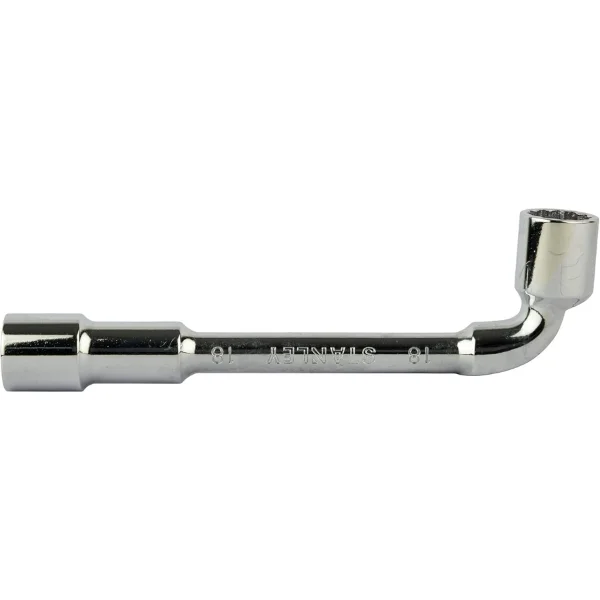
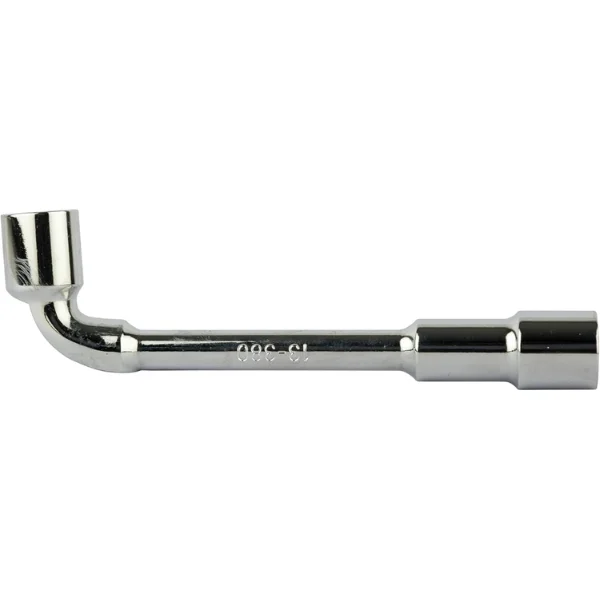
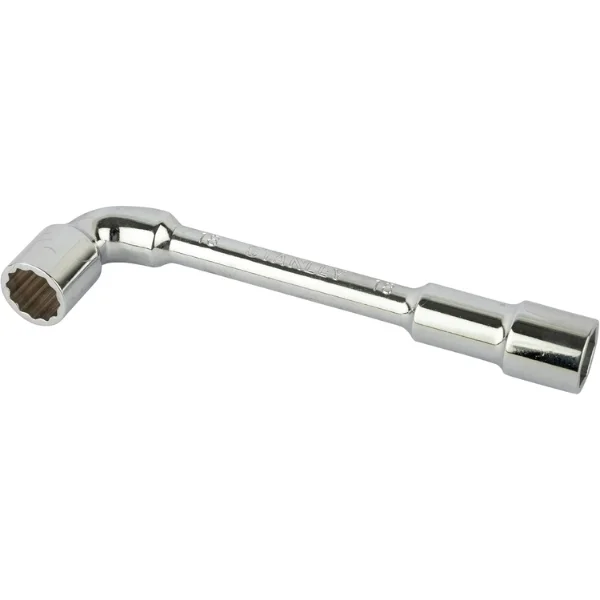
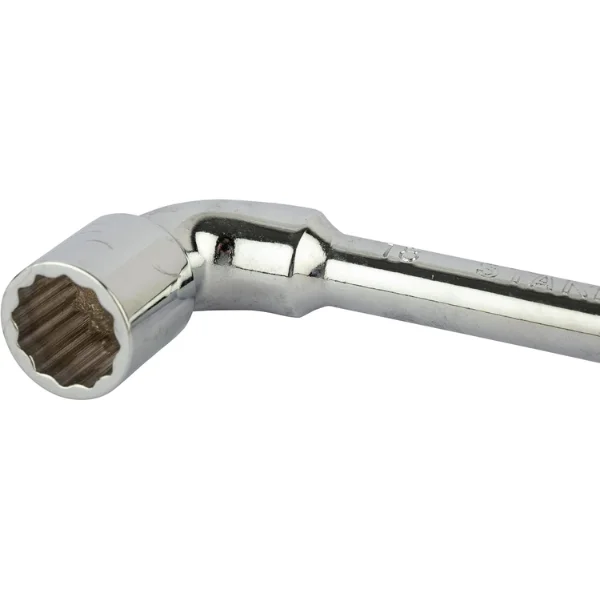
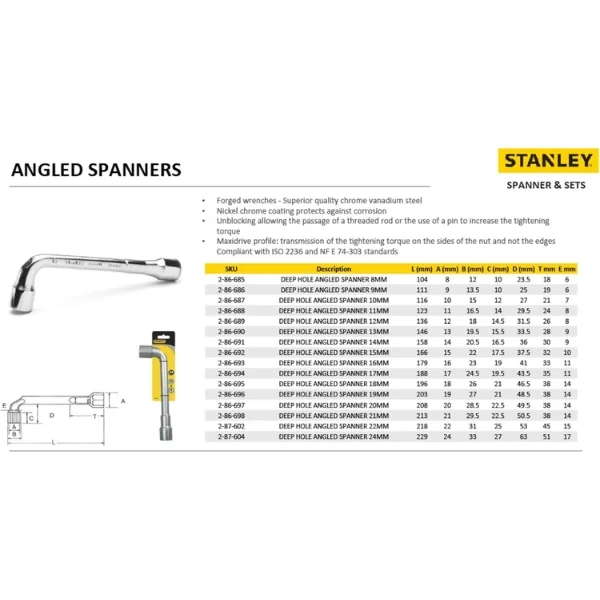
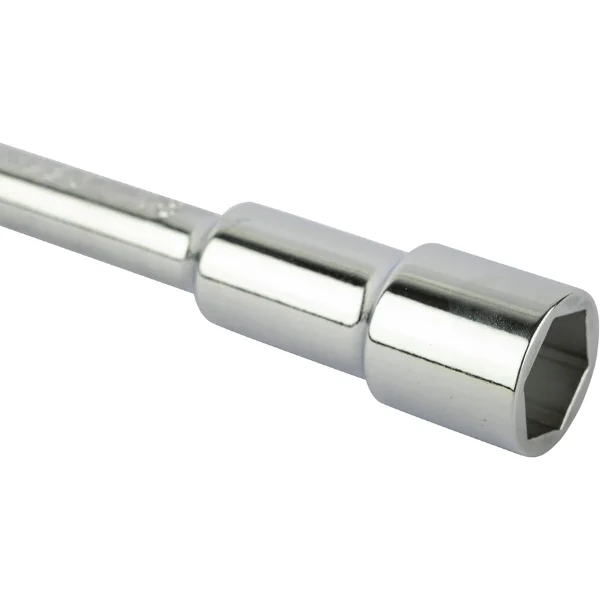
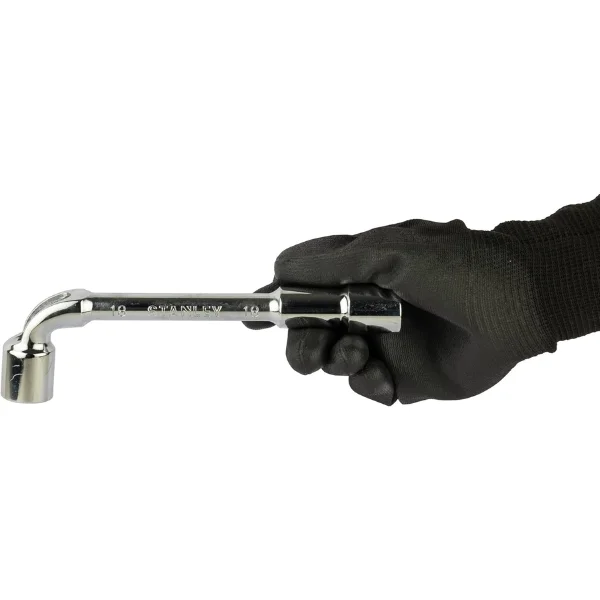
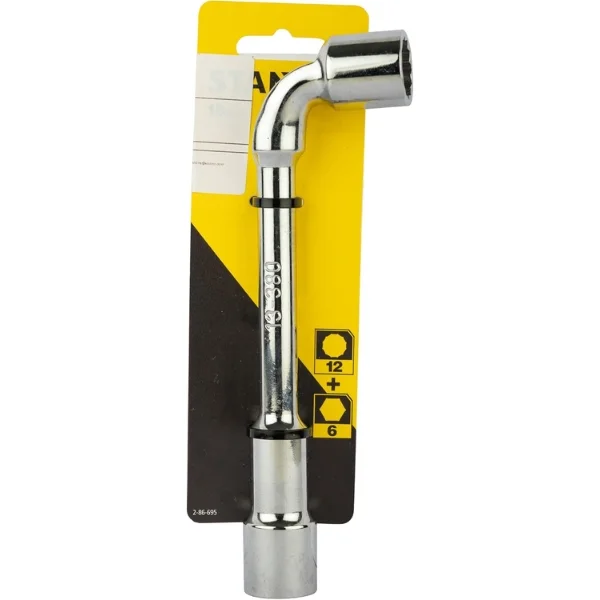
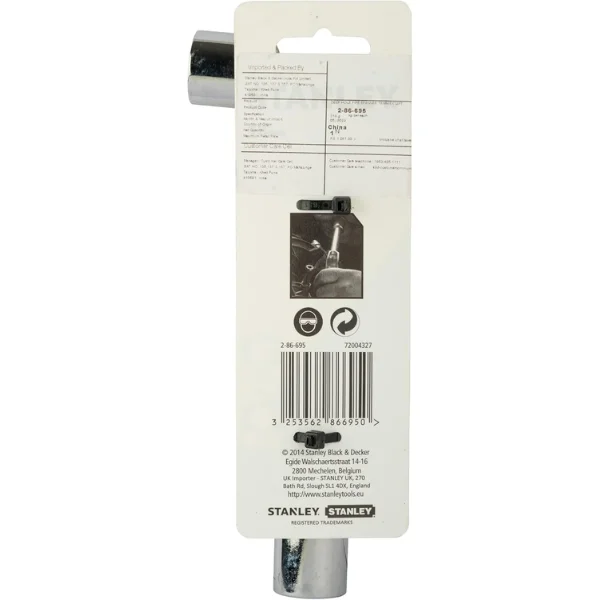


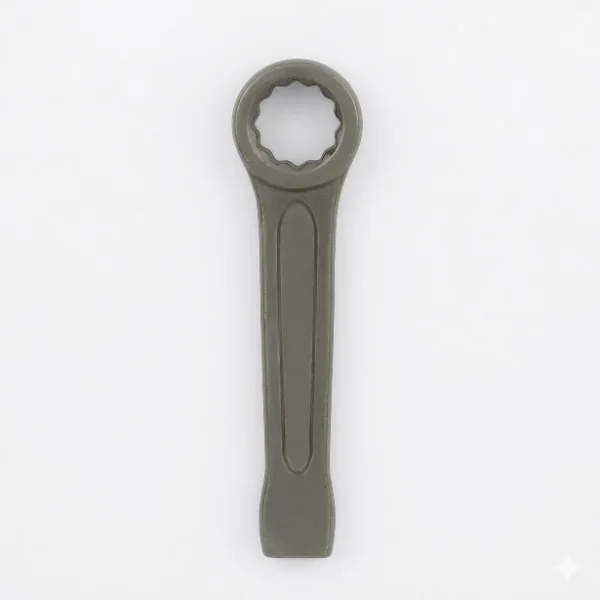
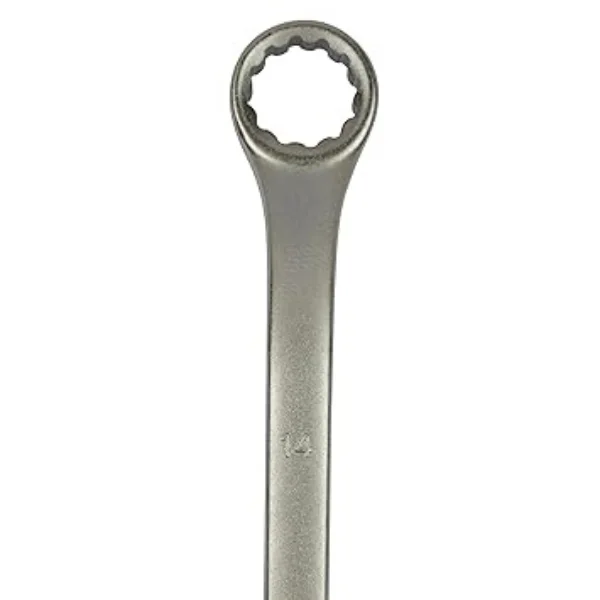
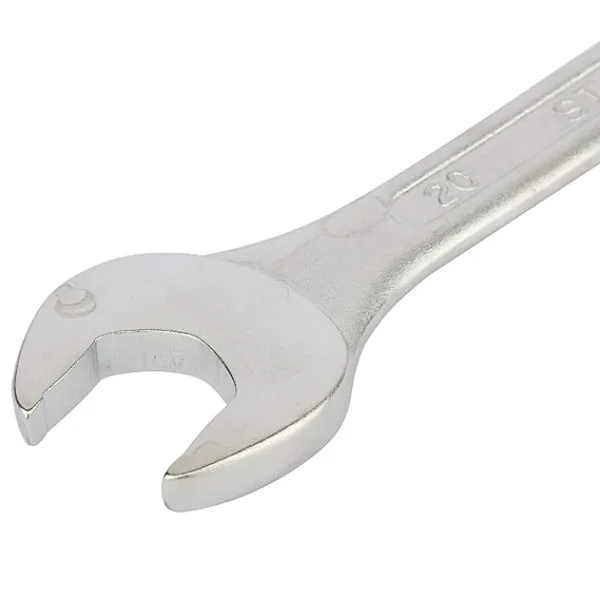
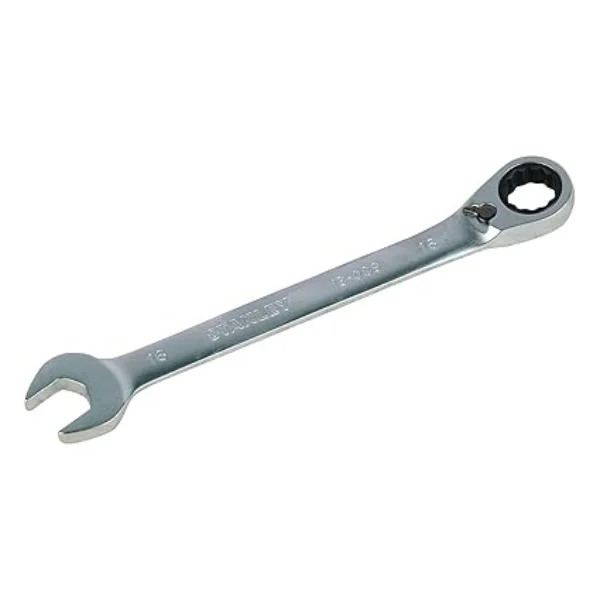
The angled head geometry allows access where standard open or ring spanners cannot reach, making it suitable for automotive repair, machinery maintenance, and industrial assembly tasks requiring precision access.
Brand: Stanley Black & Decker
STANLEY 2-86-693 Deep Hole Application Context & Use Cases
Deep hole angled spanners are used when fasteners are located inside narrow cavities or obstructed mechanical assemblies. The angled head allows the technician to maintain contact with the fastener even when direct access is blocked.
Typical Industrial Applications
Automotive Engine Maintenance
Technicians frequently encounter deep-seated bolts in engine compartments where direct access with a socket or standard spanner is impossible.
Typical examples:
Engine mounting brackets
Alternator assembly bolts
Exhaust manifold fasteners
Industrial Machinery Servicing
Maintenance teams servicing machinery often encounter recessed hex bolts inside machine frames or protective housings.
Common scenarios include:
Conveyor systems
Mechanical drive units
Pump assemblies
Mechanical Installation Projects
During installation of mechanical components, fasteners may be placed within recessed brackets or confined structural sections.
Typical environments:
Equipment installation
Fabrication workshops
Plant construction projects
How to Choose Correctly STANLEY 2-86-693 Deep Hole Angled ?
Choosing the correct angled spanner requires evaluation of fastener size, access depth, and working angle.
Confirm Fastener Size
Before purchasing, verify the hex bolt head size.
Use this spanner only when:
Fastener head = 16 mm
Access path is restricted or recessed
Assess Access Geometry
Evaluate whether the fastener location requires:
Offset access
Angled tool entry
Deep hole reach
Standard spanners may fail if obstructions prevent direct alignment.
Evaluate Torque Requirements
Deep hole spanners are designed primarily for:
Moderate torque operations
Precision tightening
For extremely high torque tasks, technicians may prefer:
Socket wrench
Breaker bar
Capacity / Calculation Example
Practical Torque Logic
A 16 mm fastener typically corresponds to M10 or M12 bolts depending on thread standard.
Typical torque range:
Bolt Type |
Approx Torque Range |
|
M10 Bolt |
45–60 Nm |
|
M12 Bolt |
80–100 Nm |
The spanner provides sufficient leverage to apply torque within these ranges during:
Mechanical assembly
Routine maintenance
However, technicians should ensure steady force application to prevent slippage.
Failure Conditions & Misuse Risks
Improper usage can lead to tool damage or fastener rounding.
Common Failure Scenarios
Incorrect Fastener Size
Using the spanner on a bolt smaller or larger than 16 mm can cause:
Fastener rounding
Tool edge damage
Excessive Torque
Applying torque beyond the tool’s intended capacity may lead to:
Head deformation
Tool bending
Improper Angle Engagement
If the tool does not seat fully on the fastener head:
Slippage may occur
Fastener edges may round
Material / Compatibility Table
Material Characteristics
The tool is manufactured using chrome vanadium steel, a standard material used in professional hand tools.
Material Property Table
Material Property |
Benefit |
|
Chrome Vanadium Steel |
High strength |
|
Hardened Structure |
Wear resistance |
|
Corrosion-Resistant Finish |
Longer service life |
|
Precision Machined Head |
Accurate fastener fit |
Operational Handling & Installation Considerations
Proper handling ensures tool longevity and fastener protection.
Correct Positioning
Ensure the spanner:
Fully seats on the fastener
Is aligned with the bolt axis
Partial contact increases risk of slippage.
Force Application
Technicians should apply:
Controlled force
Steady pulling motion
Avoid sudden jerking which can damage the tool.
Maintenance Practices
Recommended practices include:
Clean tool after use
Store in dry toolbox
Inspect head edges periodically
Commercial Clarity
As an industrial supplier, the focus is reliable procurement and dispatch capability.
Lead Time
Typical dispatch timelines depend on stock availability.
Common supply model:
Immediate dispatch for stocked items
Short lead time for replenishment orders
Dispatch Capability
Supply capability supports Pan-India shipment to industrial locations, including:
manufacturing facilities
service workshops
maintenance contractors
MOQ (Minimum Order Quantity)
Standard supply generally allows:
single-unit procurement
bulk tool orders for workshops
Customization Availability
This product is a standard manufacturer specification.
No physical customization is applied.
Compliance / Certification
Products are supplied according to manufacturer specifications from Stanley Black & Decker.
Tender Compatibility
Industrial buyers may request:
GST invoice
product specification confirmation
brand verification
These documents support procurement processes including corporate purchasing and maintenance contracts.
STANLEY 2-86-693 Procurement Process
Industrial buyers typically follow a straightforward procurement process.
Information to Provide During Enquiry
To process supply efficiently, include:
Product name
Model number: 2-86-693
Required quantity
Delivery location
Procurement Flow
Submit product enquiry
Receive quotation
Confirm order and delivery details
Dispatch arranged
This process supports maintenance teams requiring fast procurement decisions.
Comparison Table
Tool Type |
Best Use Case |
Limitation |
|
Deep Hole Angled Spanner |
Recessed bolts with restricted access |
Limited torque compared to sockets |
|
Ring Spanner |
High grip on exposed fasteners |
Cannot reach deep cavities |
|
Open End Spanner |
Quick adjustment in open access areas |
Lower grip strength |
|
Socket Wrench |
High torque applications |
Requires direct access |
This comparison helps technicians choose the correct tool for access conditions.
Selection Checklist
Before purchasing, verify the following:
Fastener size is 16 mm
Bolt location is recessed or obstructed
Standard socket cannot access the fastener
Required torque is within manual spanner range
Application involves mechanical or automotive maintenance
If all conditions match, this spanner is an appropriate selection.
High-Intent FAQs
Is the STANLEY 2-86-693 spanner suitable for automotive repair?
Yes. It is commonly used in automotive servicing where bolts are recessed within engine assemblies or mechanical brackets.
What type of bolts does a 16 mm spanner typically fit?
A 16 mm spanner fits hex bolts with 16 mm head size, often associated with M10 or M12 fasteners depending on standards.
When should a deep hole angled spanner be used instead of a socket?
It should be used when socket access is blocked by surrounding components and the fastener can only be reached from an angled approach.
Is this tool suitable for heavy torque applications?
It is designed for controlled manual torque, not heavy torque tasks that require breaker bars or impact tools.
Can this spanner be used in industrial machinery maintenance?
Yes. Maintenance teams commonly use it to access recessed bolts within machine frames or mechanical assemblies.
How do I verify the correct product before ordering?
Model number 2-86-693
Spanner size 16 mm
Application requiring angled access
Technical Configuration Overview
STANLEY 2-86-693 Technical Specifications
The spanner is engineered to provide controlled torque transfer while maintaining accessibility in recessed areas.
Technical Specification Table
Specification Parameter |
Value |
|
Product Model |
2-86-693 |
|
Tool Type |
Deep Hole Angled Spanner |
|
Size |
16 mm |
|
Brand |
Stanley |
|
Material |
Chrome Vanadium Steel |
|
Finish |
Corrosion-resistant finish |
|
Head Type |
Angled |
|
Application |
Recessed hex fasteners |
|
Standard Use |
Mechanical & automotive maintenance |







Customer reviews