



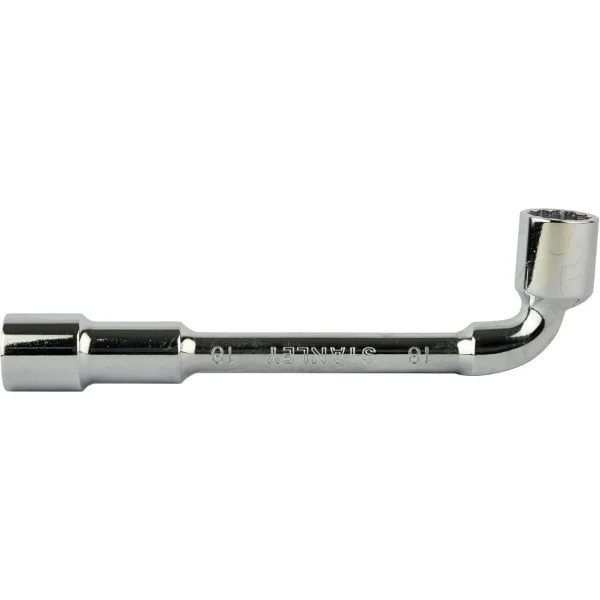
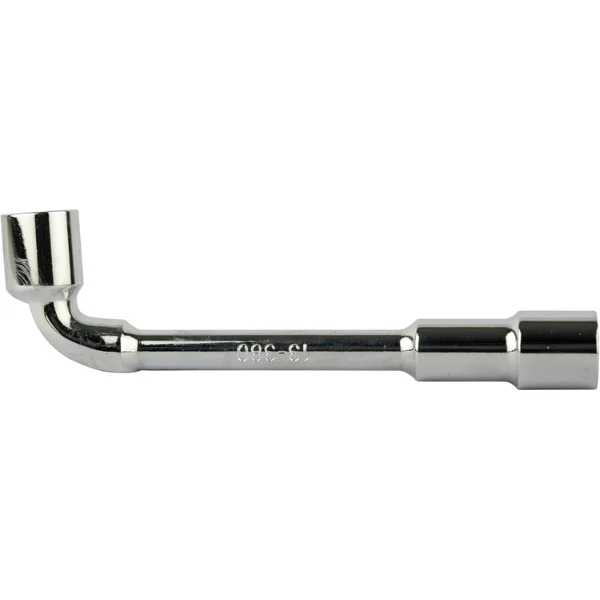
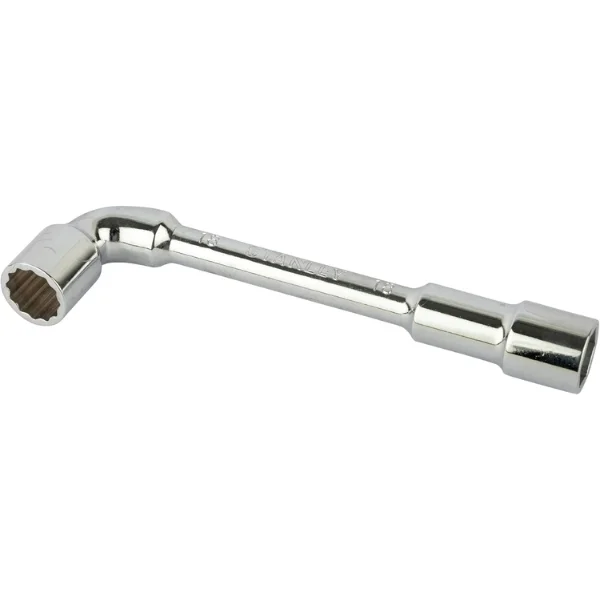
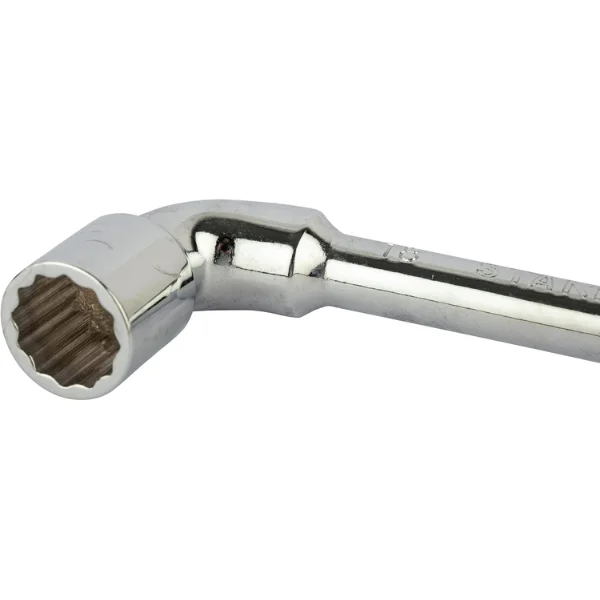
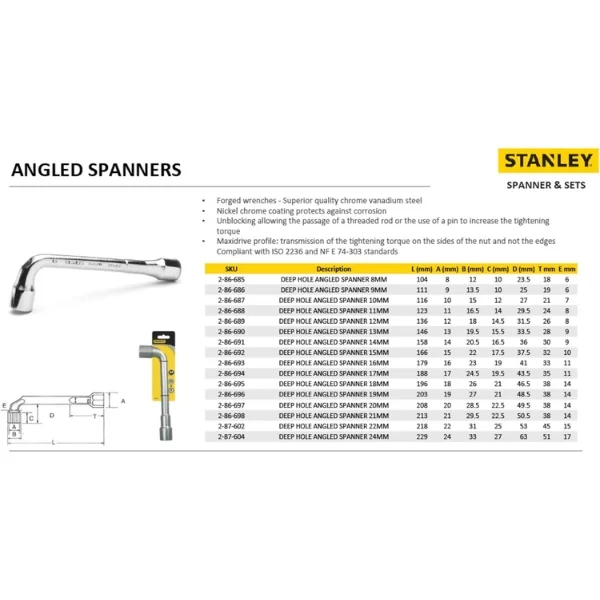
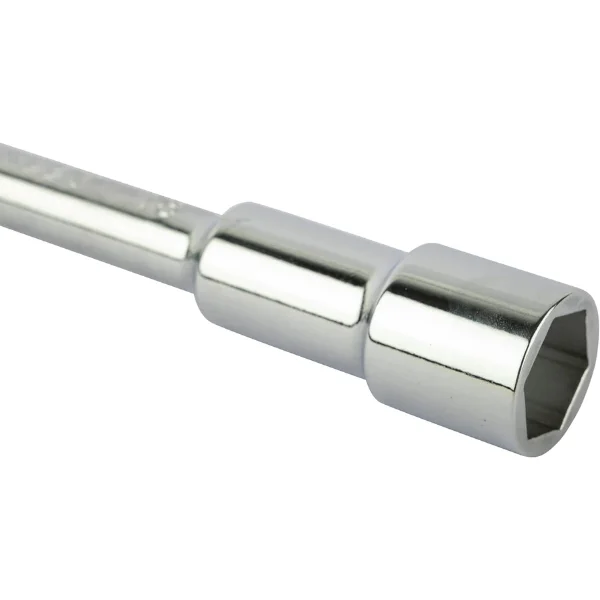
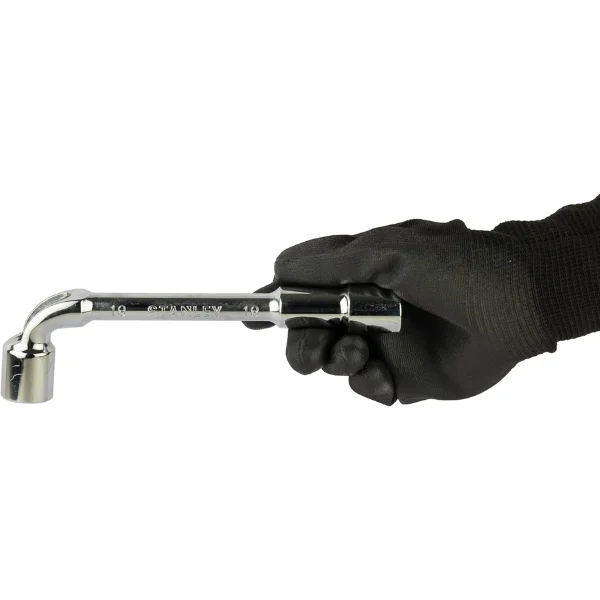
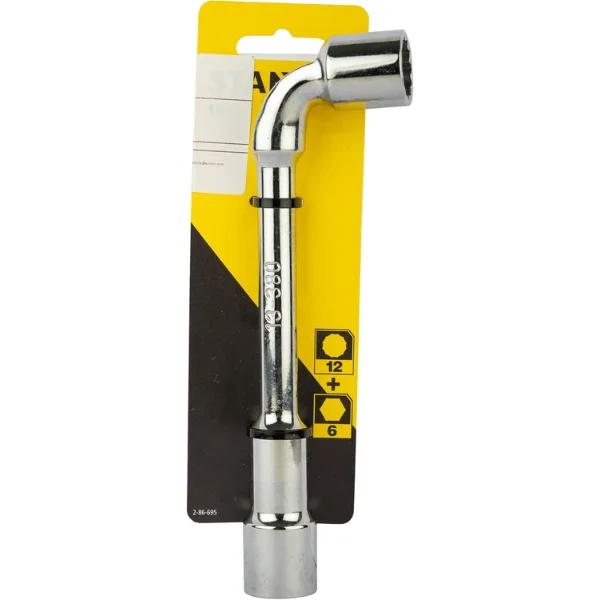
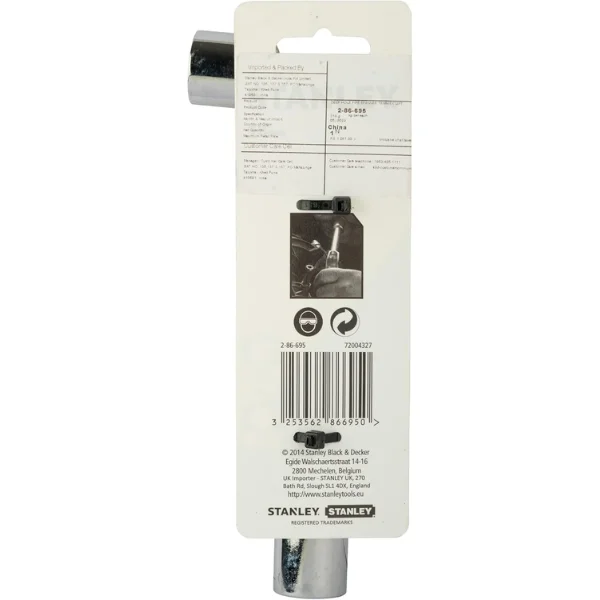


This tool is typically used in industrial maintenance, automotive repair, machinery servicing, and equipment assembly, where fasteners are positioned inside deep housings or structural frames.
Stanley 2-86-695 Application Context & Use Cases
Deep-access spanners are not general workshop tools. They are normally used in situations where fasteners are positioned inside confined mechanical assemblies.
Typical Industrial Scenarios
• Machinery frame assemblies with recessed bolts
• Automotive engine components
• Structural mounting brackets
• Industrial pumps and compressors
• Maintenance of equipment with deep housing bolts
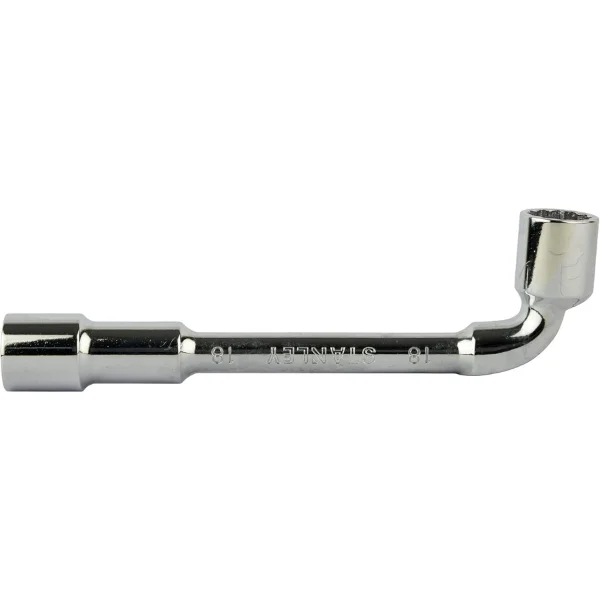
Why a Deep Hole Angled Spanner Is Required
Standard ring spanners work when the bolt head is exposed. However, when a fastener sits inside a deep cavity or recessed component, the spanner must reach further while maintaining full contact with the nut.
The angled design also provides clearance between the operator’s hand and surrounding equipment, allowing torque to be applied without obstruction.
Practical Example
Maintenance technicians servicing industrial pumps frequently encounter bolts recessed inside the pump housing. A normal spanner cannot reach the fastener because the surrounding casing blocks tool access.
A deep hole angled spanner solves this by extending the ring further into the cavity while offsetting the handle for clearance.
Selection Guidance
Choosing the correct deep hole spanner depends on several practical considerations.
Confirm Fastener Size
The spanner size must match the exact fastener head size.
Example:
Fastener Head |
Required Spanner |
|
18 mm hex head |
18 mm ring spanner |
Incorrect sizing can result in rounding or slippage.
Check Recess Depth
Before selecting a deep hole spanner, measure the approximate distance between the surface opening and bolt head.
If the recess is shallow, a standard ring spanner may be sufficient.
If the bolt is deeply positioned, a deep reach design becomes necessary.
Assess Access Angle
Some fasteners cannot be accessed vertically due to nearby components. The angled spanner head allows the user to apply torque without interfering with surrounding structures.
Capacity / Practical Calculation Example
Although hand tools are not rated like power tools, torque capacity depends on operator force and tool leverage.
Example Calculation
Assume:
Operator applies force: 150 N
Spanner length: 0.25 m
Torque generated:
Torque = Force × Length
Torque = 150 N × 0.25 m
Torque = 37.5 Nm
This torque level is sufficient for many medium-size mechanical fasteners used in automotive or industrial assemblies.
Why Proper Engagement Matters
If the spanner does not fully seat on the fastener, the applied torque is transferred unevenly. This can lead to:
• bolt rounding
• tool slippage
• hand injury
Deep ring spanners maintain complete engagement with the fastener head, improving torque transfer.
Failure Conditions & Misuse Risks
Improper use of hand tools can result in damage to both the tool and the fastener.
Common Misuse Conditions
• Using incorrect size spanner
• Applying excessive torque with extension bars
• Using damaged or worn tools
• Hammering the spanner handle
Fastener Damage Risks
Incorrect tool selection can cause:
• rounding of hex heads
• stripped fasteners
• uneven torque distribution
When a bolt head becomes rounded, removal becomes significantly more difficult and may require extraction tools.
Material & Compatibility Table
Fastener Compatibility
Fastener Type |
Compatibility |
|
Hex head bolts |
Compatible |
|
Hex nuts |
Compatible |
|
Flange bolts |
Compatible |
|
Square fasteners |
Not recommended |
Common Application Industries
Industry |
Typical Use |
|
Automotive repair |
Engine assemblies |
|
Machinery maintenance |
Recessed frame bolts |
|
Manufacturing |
Assembly lines |
|
Industrial service |
Pump and compressor maintenance |
Operational Handling & Installation Considerations
Correct handling improves safety and tool lifespan.
Proper Tool Engagement
The spanner ring should fully seat over the fastener before applying torque.
Partial engagement increases the risk of:
• slippage
• fastener damage
• operator injury
Operator Clearance
The angled handle provides clearance between the operator’s hand and surrounding equipment.
When working inside tight machinery spaces, technicians should ensure that the handle swing path remains unobstructed.
Commercial Clarity
Lead Time
Stock availability varies depending on order volume. Standard orders are typically dispatched within normal supplier processing timelines.
Dispatch Capability
Pan-India logistics support allows shipment to:
• industrial plants
• workshops
• distributor warehouses
• project sites
Minimum Order Quantity
Small quantities are supported for maintenance buyers. Bulk orders may be arranged for distributor supply.
Customization Availability
This is a standard manufacturer model. Dimensional customization is not available.
Compliance / Certification
The tool is supplied as an original branded product manufactured under the quality standards of Stanley.
Tender Compatibility
Product supply can support:
• industrial procurement
• project maintenance toolkits
• distributor restocking
Documentation requirements can be provided during procurement discussions.
Procurement Process
To process an enquiry efficiently, buyers typically provide:
Required Information
• Product model number
• Required quantity
• Delivery location
• Company name and contact details
Enquiry Flow
Submit RFQ or enquiry request
Supplier confirms product availability
Commercial quotation issued
Dispatch schedule confirmed
Shipment arranged
Comparison Table
Deep Hole Angled Spanner vs Standard Alternatives
Feature |
Deep Hole Angled Spanner |
Standard Ring Spanner |
Adjustable Spanner |
|
Recessed bolt access |
Excellent |
Limited |
Poor |
|
Torque transmission |
High |
High |
Moderate |
|
Fastener fit accuracy |
Precise |
Precise |
Variable |
|
Use in confined assemblies |
Suitable |
Often restricted |
Not recommended |
|
Fastener protection |
Good |
Good |
Moderate |
Selection Checklist
Before ordering this tool, confirm the following:
• Fastener head size is 18 mm
• Bolt is positioned inside a recess or cavity
• A standard spanner cannot reach the fastener
• Required torque falls within normal hand-tool limits
• Operator clearance requires an angled tool head
If these conditions apply, a deep hole angled spanner is appropriate.
High-Intent FAQs
What is the purpose of a deep hole angled spanner?
A deep hole angled spanner is designed to tighten or loosen fasteners located inside recessed or obstructed assemblies where standard spanners cannot reach the bolt head.
Is the Stanley 2-86-695 spanner suitable for industrial maintenance?
Yes. The tool is commonly used in industrial maintenance environments where recessed bolts must be serviced without dismantling surrounding equipment.
Can this spanner be used for standard bolts?
It can be used on exposed bolts, but its primary benefit is accessing deep or obstructed fasteners.
Does this tool replace a torque wrench?
No. Torque wrenches are required where precise torque measurement is necessary. A ring spanner provides manual torque application.
What industries commonly use deep hole spanners?
Automotive repair, industrial maintenance, manufacturing assembly, and mechanical servicing operations frequently require deep-access spanners.
Is the Stanley 2-86-695 available for bulk orders?
Bulk procurement is commonly required by workshops, maintenance contractors, and distributors.
Technical Configuration Overview
Stanley Spanner 18mm Technical Specifications
|
Parameter |
Specification |
|
Brand |
Stanley |
|
Model Number |
2-86-695 |
|
Tool Type |
Deep Hole Angled Ring Spanner |
|
Nominal Size |
18 mm |
|
Material |
Chrome Vanadium Steel |
|
Surface Finish |
Corrosion-resistant plating |
|
Ring Design |
Deep reach ring profile |
|
Head Geometry |
Angled offset |
|
Intended Use |
Accessing recessed 18 mm fasteners |
Dimensional Considerations
Feature |
Purpose |
|
Deep ring |
Allows engagement with recessed bolts |
|
Angled head |
Provides working clearance |
|
Narrow profile |
Fits inside confined spaces |







Customer reviews