



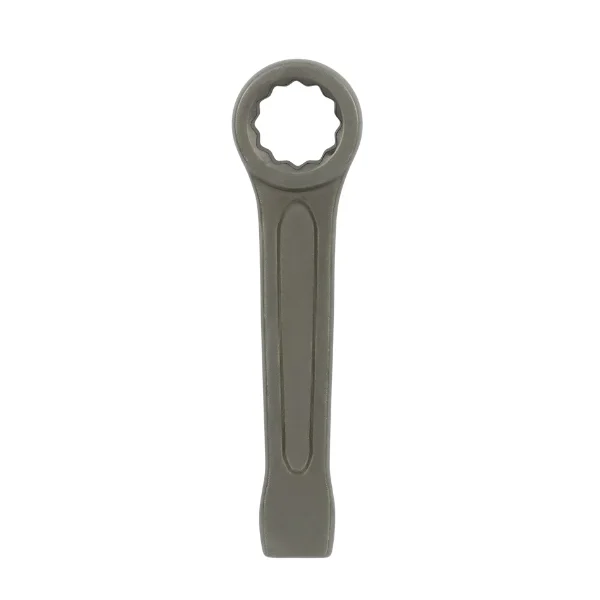
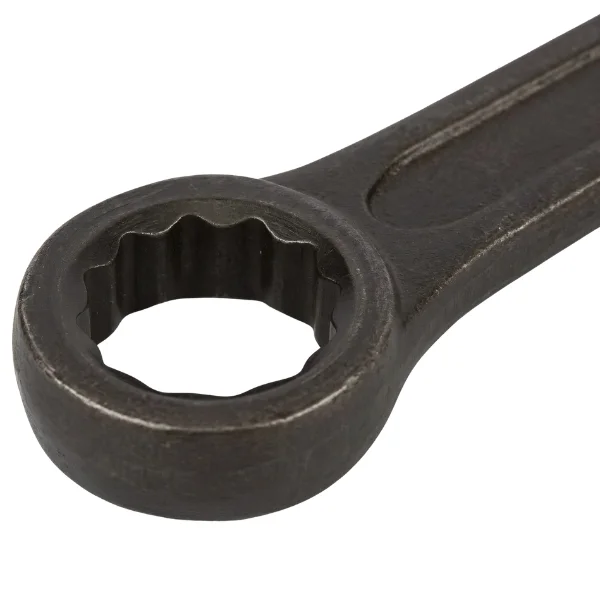
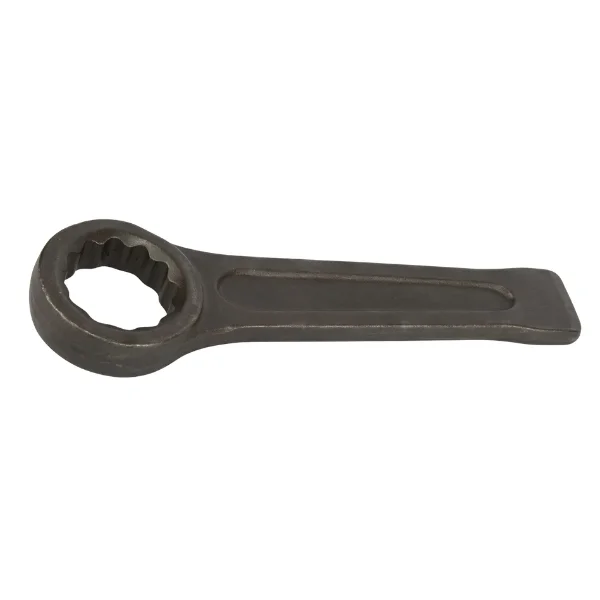
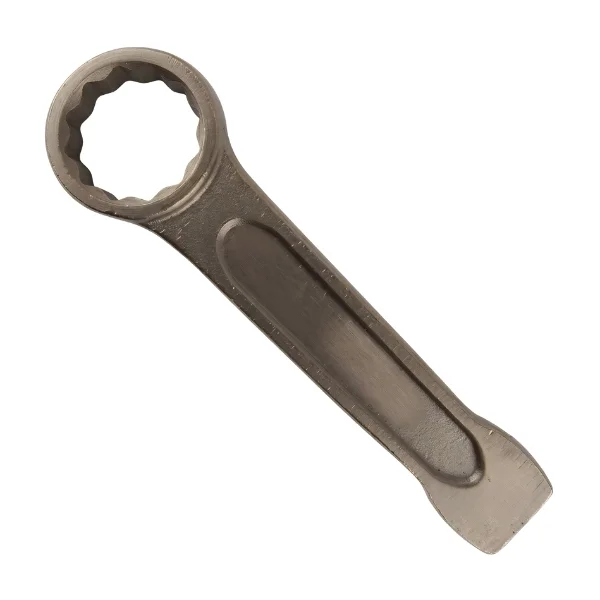


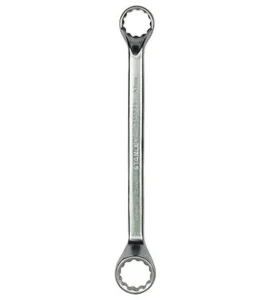
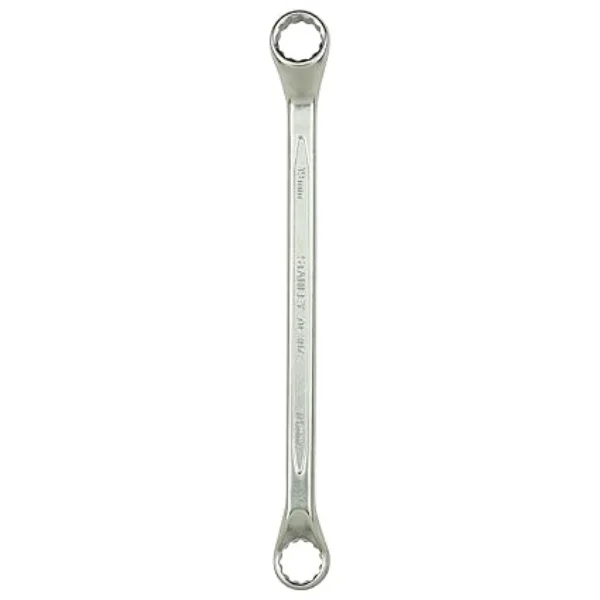
The closed ring profile distributes impact forces around the bolt head, enabling high torque application during equipment installation, plant shutdown maintenance, and heavy machinery servicing where conventional torque tools are impractical.
Application Context & Use Cases
Large fasteners used in heavy industry cannot always be removed with standard torque tools. Situations such as corrosion, thermal expansion, or limited clearance require impact-driven wrenching.
The 100 mm ring-end slogging spanner is typically used in environments where:
Bolts exceed standard wrench capacity
Hydraulic torque tools are unavailable or impractical
Maintenance crews require manual high-impact torque application
Common Industrial Use Cases
Refinery and Petrochemical Maintenance
Used during shutdown operations to loosen large flange bolts, valve assemblies, and pipeline connections exposed to high temperatures and corrosion.
Power Plant Equipment Installation
Used for turbine casing bolts, boiler structure fasteners, and heavy equipment anchor bolts.
Steel Plant Maintenance
Maintenance crews use slogging spanners for rolling mill equipment, heavy structural joints, and furnace assemblies.
Mining Equipment Service
Applied when servicing excavators, crushers, and haul truck assemblies using large diameter bolts.
Shipyard and Marine Engineering
Used for propulsion system mounts, engine bedplate fasteners, and large structural bolting systems.
The ring-end design allows uniform load distribution, reducing bolt damage during hammer impact.
Selection Guidance – Choosing the Correct Slogging Spanner
Selecting the correct slogging spanner size requires alignment with bolt head dimension rather than thread diameter.
Understanding Bolt Head vs Spanner Size
Large hex bolts follow standardized head dimensions. The spanner size corresponds to across-flat distance of the bolt head.
Example:
Bolt Size |
Typical Head Size |
Required Spanner |
|
M64 |
~95 mm |
95 mm spanner |
|
M68 |
~100 mm |
100 mm spanner |
|
M72 |
~105 mm |
105 mm spanner |
Therefore, a 100 mm slogging spanner is typically selected for M68 class hex fasteners.
When a Ring-End Design is Preferred
Choose ring-end slogging spanners when:
Bolt head rounding must be avoided
High torque is required
Impact forces are expected
Fastener access allows full ring engagement
Open-end slogging spanners are used when clearance restrictions prevent ring access.
Capacity Calculation Example (Practical Field Logic)
Hammer-driven torque depends on hammer weight and strike velocity.
Simplified Torque Estimate
Torque generated ≈
Hammer force × spanner length
Example field scenario:
Hammer weight: 5 kg
Impact velocity: ~5 m/s
Effective spanner length: 0.8 m
Approximate torque delivered:
2,500 – 4,000 Nm per strike
This level of torque is sufficient to loosen many large structural or flange bolts used in industrial equipment.
Actual torque varies depending on:
hammer mass
strike angle
friction conditions
corrosion
Failure Conditions & Misuse Risks
Improper use of slogging spanners can result in tool damage or safety hazards.
Common Failure Causes
Misaligned Hammer Strike
Impact outside the striking zone may cause:
tool deformation
edge cracking
uncontrolled deflection
Incorrect Size Selection
Using a larger spanner on a smaller bolt head can lead to:
bolt head rounding
slippage under impact
Excessive Hammer Weight
Oversized striking tools can cause:
spanner fracture
operator injury
Repeated Side Loading
Slogging spanners are designed for linear hammer impact, not sideways prying.
Material & Compatibility Reference
Bolt Material Compatibility
Bolt Material |
Compatibility |
|
Carbon Steel Bolts |
Suitable |
|
Alloy Steel Bolts |
Suitable |
|
Structural Fasteners |
Suitable |
|
Stainless Steel Bolts |
Suitable with controlled impact |
Industrial Sector Compatibility
Industry |
Typical Application |
|
Oil & Gas |
Pipeline flange bolts |
|
Power Plants |
Turbine housing fasteners |
|
Steel Plants |
Furnace structures |
|
Mining |
Crusher assemblies |
|
Marine Engineering |
Engine mounts |
Operational Handling & Installation Considerations
Proper Impact Technique
Operators should follow these steps:
Seat the ring fully onto the bolt head.
Align the striking end away from personnel.
Strike using controlled hammer blows.
Maintain stable footing during impact.
Safety Considerations
Recommended safety equipment includes:
industrial safety gloves
face shield or safety goggles
steel toe boots
Hammer striking tools should be inspected before use to prevent fragmentation hazards.
Commercial Clarity
Lead Time
Typical dispatch timelines depend on stock availability and order quantity.
Standard industrial tools are generally supplied within normal dispatch cycles.
Dispatch Capability
Supply can be arranged Pan-India through industrial logistics networks, including delivery to:
project sites
fabrication yards
plant maintenance stores
Minimum Order Quantity
Industrial hand tools are typically supplied per unit or project-based quantities, depending on procurement requirements.
Customization Availability
This product is a standard manufacturer specification tool.
Customization is generally not applicable except in bulk industrial procurement packaging.
Compliance & Certification
STANLEY tools are manufactured under recognized industrial production standards and are widely accepted across industrial maintenance environments.
Tender Compatibility
Industrial procurement teams and EPC contractors frequently specify recognized global tool brands in tender documentation.
Brand-specified tools such as STANLEY are commonly used where reliability and tool integrity are critical.
Procurement Process – How to Enquire
Industrial procurement teams should provide the following information when requesting supply:
Product model or size requirement
Required quantity
Delivery location
Project or maintenance context
Required delivery timeline
Providing these details allows faster quotation and supply confirmation.
Comparison – Ring-End vs Alternative Tools
|
Tool Type |
Typical Use |
Limitation |
|
Ring-End Slogging Spanner |
High torque impact on large bolts |
Requires full bolt head access |
|
Open-End Slogging Spanner |
Restricted bolt clearance |
Higher risk of bolt rounding |
|
Hydraulic Torque Wrench |
Precise torque control |
Expensive and requires setup |
|
Adjustable Wrench |
General maintenance |
Not suitable for large impact loads |
For large industrial fasteners, ring-end slogging spanners provide the most secure engagement under hammer impact.
Selection Checklist – Procurement Validation
Before purchasing a 100 mm slogging spanner, confirm the following:
Bolt head dimension matches 100 mm across flats
Access clearance allows ring-end engagement
Maintenance team uses hammer-driven torque tools
Tool will be used in industrial maintenance operations
Required torque exceeds standard wrench capability
Equipment involves large structural fasteners
This validation helps prevent incorrect tool selection.
High-Intent FAQs
What bolt size typically requires a 100 mm slogging spanner?
A 100 mm spanner usually corresponds to large hex bolt heads used on M68 class fasteners, though exact dimensions depend on bolt standards.
Can this spanner be used with hydraulic torque tools?
No. Slogging spanners are designed for manual hammer impact, not hydraulic torque systems.
Is a ring-end spanner better than an open-end slogging spanner?
Ring-end spanners provide full bolt head engagement, reducing the risk of slippage and bolt damage during impact.
What hammer weight is typically used with this tool?
Maintenance crews commonly use 4–6 kg sledge hammers for controlled torque generation.
Can this spanner loosen seized industrial bolts?
Yes. Hammer-driven impact often helps break corrosion bonds that prevent conventional wrenching.
Are slogging spanners suitable for continuous tightening work?
They are typically used for loosening stubborn fasteners or initial tightening, not for final calibrated torque.
How should the tool be inspected before use?
Operators should check for:
cracks near the striking end
deformation of the ring profile
mushrooming on the striking surface
Damaged tools should be removed from service.
Technical Configuration Overview
Technical Specifications
Product Identification
Specification |
Detail |
|
Product Brand |
STANLEY |
|
Model Number |
STMT96975 |
|
Tool Type |
Ring-End Slogging Spanner |
|
Nominal Size |
100 mm |
|
Application |
Impact-driven bolt tightening / loosening |
|
Tool Category |
Industrial hand tool |
Construction Characteristics
Parameter |
Description |
|
Spanner Profile |
Closed ring impact wrench |
|
Material |
Industrial alloy steel |
|
Manufacturing Process |
Forged construction |
|
Heat Treatment |
Hardened for impact resistance |
|
Surface Finish |
Corrosion-resistant finish |
|
Impact Method |
Hammer strike on striking end |
Functional Attributes
Attribute |
Operational Benefit |
|
Ring-End Design |
Even torque distribution across bolt head |
|
Thick Forged Body |
Withstands repeated hammer impact |
|
Offset Geometry |
Provides clearance for bolt engagement |
|
Impact Striking End |
Designed for hammer force transmission |







Customer reviews