



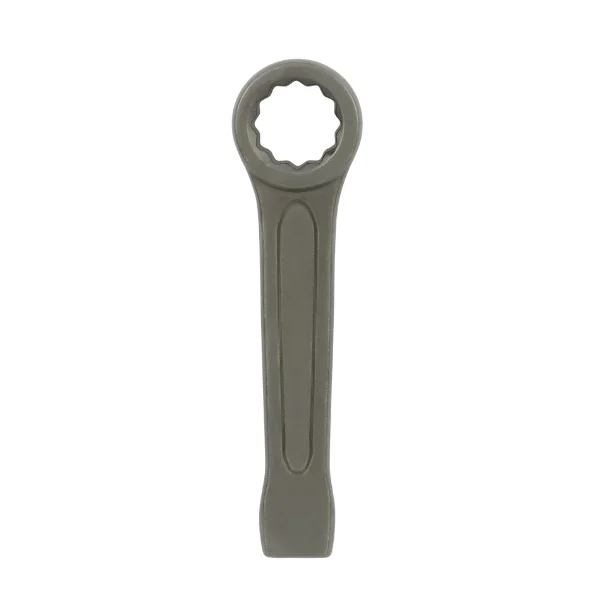
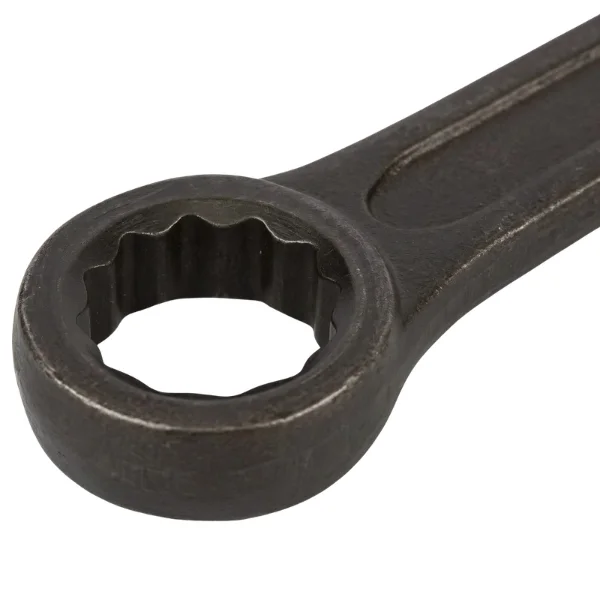
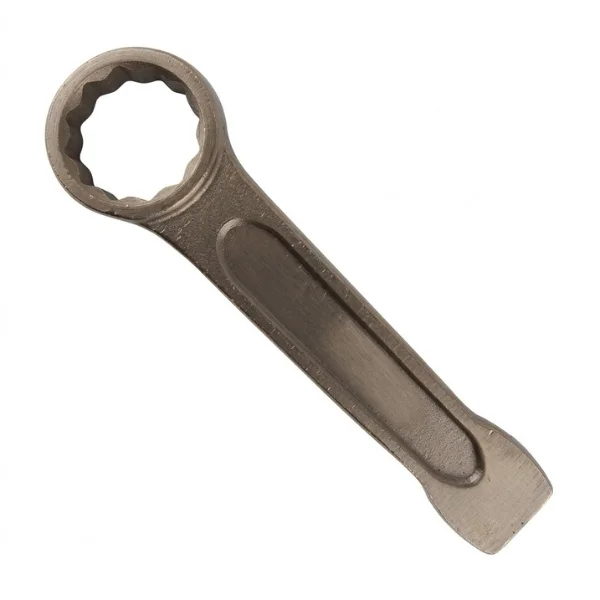
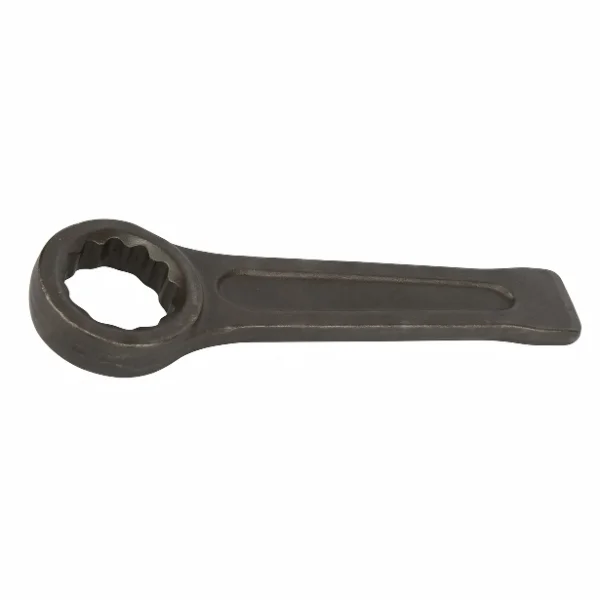


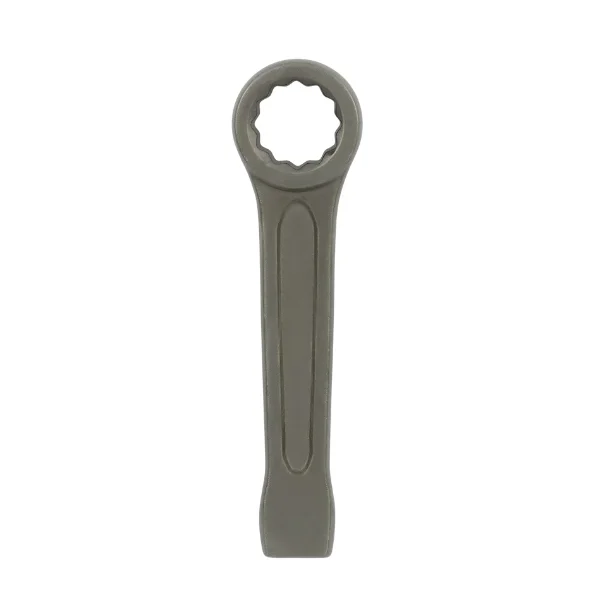
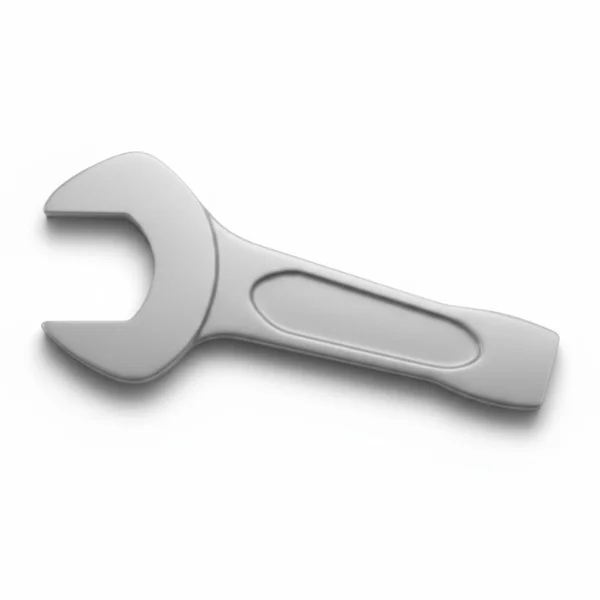
It features a closed ring head for secure bolt engagement and a reinforced striking end to withstand repeated hammer blows during maintenance of heavy equipment, structural assemblies, and large machinery.
Application Context & Use Cases
Slogging spanners are used where conventional torque tools cannot deliver sufficient force. The tool converts hammer impact into rotational torque applied to a bolt or nut.
Typical Industrial Applications
Heavy Mechanical Maintenance
Maintenance teams use slogging spanners during overhaul of:
Turbines
Compressors
Crushers
Rolling mills
Heavy pumps
Large fasteners in these systems require impact-based torque application.
Power Plant Maintenance
Used during shutdown maintenance of:
Turbine casings
Generator mountings
Steam pipeline flanges
These fasteners often exceed torque limits of standard wrenches.
Oil & Gas Facilities
In refinery environments slogging spanners are used for:
Pipeline flange bolts
Pressure vessel fasteners
Structural supports
The ring-end design prevents slippage under impact.
Infrastructure & EPC Installation
During equipment installation contractor’s use slogging spanners for:
Structural bolting
Heavy mechanical assemblies
Equipment base frame tightening
These operations require tools that tolerate high impact loads.
Selection Guidance
Choosing the correct slogging spanner is critical for safety and torque transfer efficiency.
Size Verification
The 50 mm ring size must match the nut or bolt head dimension exactly.
Incorrect size selection can lead to:
Rounding of bolt corners
Tool slippage
Reduced torque transmission
Bolt Accessibility
Slogging spanners are suitable when:
Bolt heads are exposed
There is space for hammer movement
Torque requirement exceeds manual wrench capability
Restricted spaces may require alternative tools such as hydraulic torque wrenches.
Impact Method Suitability
Slogging spanners are appropriate when:
Hammer impact can be safely applied
Bolt seizure is expected
Large static torque is required
They are not suitable for controlled torque specification tightening.
Capacity & Torque Calculation Example
Slogging spanners convert hammer force into rotational torque.
Example Scenario
A technician strikes the spanner using a 4 kg hammer.
Assume:
Hammer impact force generates approximately 800–1200 N impulse
Handle length provides mechanical leverage
Torque generated depends on:
Hammer weight
Striking force
Spanner length
Number of strikes
Practical Outcome
Repeated controlled strikes gradually overcome bolt friction, allowing rotation of large fasteners that cannot be loosened with conventional spanners.
Failure Conditions & Misuse Risks
Incorrect use can lead to tool damage or safety hazards.
Common Misuse Scenarios
Incorrect Size Fitment
Using a spanner larger than the bolt size may cause:
Bolt rounding
Ring deformation
Excessive Hammer Force
Over-striking the tool can cause:
Handle bending
Ring distortion
Metal fatigue
Damaged Striking Surface
A worn striking face can:
Cause hammer rebound
Create metal fragments
Tools must be inspected regularly.
Bolt Overload
Applying excessive impact to seized bolts may cause:
Bolt shear failure
Equipment damage
Controlled force application is required.
Small Fastener Work
Slogging spanners are designed for large industrial bolts and are impractical for small mechanical assemblies.
Confined Workspaces
If hammer swing clearance is limited, alternative torque tools may be required.
Material & Compatibility Table
|
Component |
Material Type |
Compatibility |
|
Spanner Body |
Drop forged steel |
High impact industrial environments |
|
Ring Head |
Hardened steel |
Large hex bolts and nuts |
|
Striking End |
Reinforced steel |
Hammer impact |
|
Surface Finish |
Industrial protective coating |
Workshop and field use |
Operational Handling & Installation Considerations
Proper Engagement
Ensure the ring head fully seats on the bolt before striking.
Partial engagement increases risk of slippage.
Strike Direction
Hammer impact should be delivered:
Perpendicular to the striking end
In the direction required to rotate the bolt
Controlled repetitive strikes are recommended.
Safety Measures
Operators should use:
Safety gloves
Eye protection
Stable footing
These precautions reduce risk during high-impact operations.
Commercial Clarity
Lead Time
Availability depends on current stock position.
For stocked items, dispatch can typically be arranged shortly after order confirmation.
Dispatch Capability
Pan-India shipping supported through industrial logistics networks.
Dispatch options include:
Surface transport
Courier logistics for urgent orders
Delivery timelines depend on destination city.
Minimum Order Quantity (MOQ)
MOQ may vary depending on supply conditions.
Single-unit procurement is generally supported for maintenance requirements.
Customization
This is a standard branded tool and is supplied according to manufacturer specifications.
Customization is not applicable.
Compliance & Certification
Product supply corresponds to standard manufacturer specifications.
Documentation may include:
GST-compliant invoice
Product identification details
Tender Compatibility
Industrial tenders referencing the following specification may include this tool:
STANLEY STMT96965
50 mm ring-end slogging spanner
Procurement teams may request formal quotations.
Procurement Process
Industrial buyers can expedite enquiry by providing:
Required Information
Product model number
Quantity required
Delivery location
Company name
GST details (for quotation)
Typical Procurement Steps
Submit enquiry with required details
Supplier confirms availability
Quotation issued
Order confirmation
Dispatch and shipment tracking
Comparison Table
|
Feature |
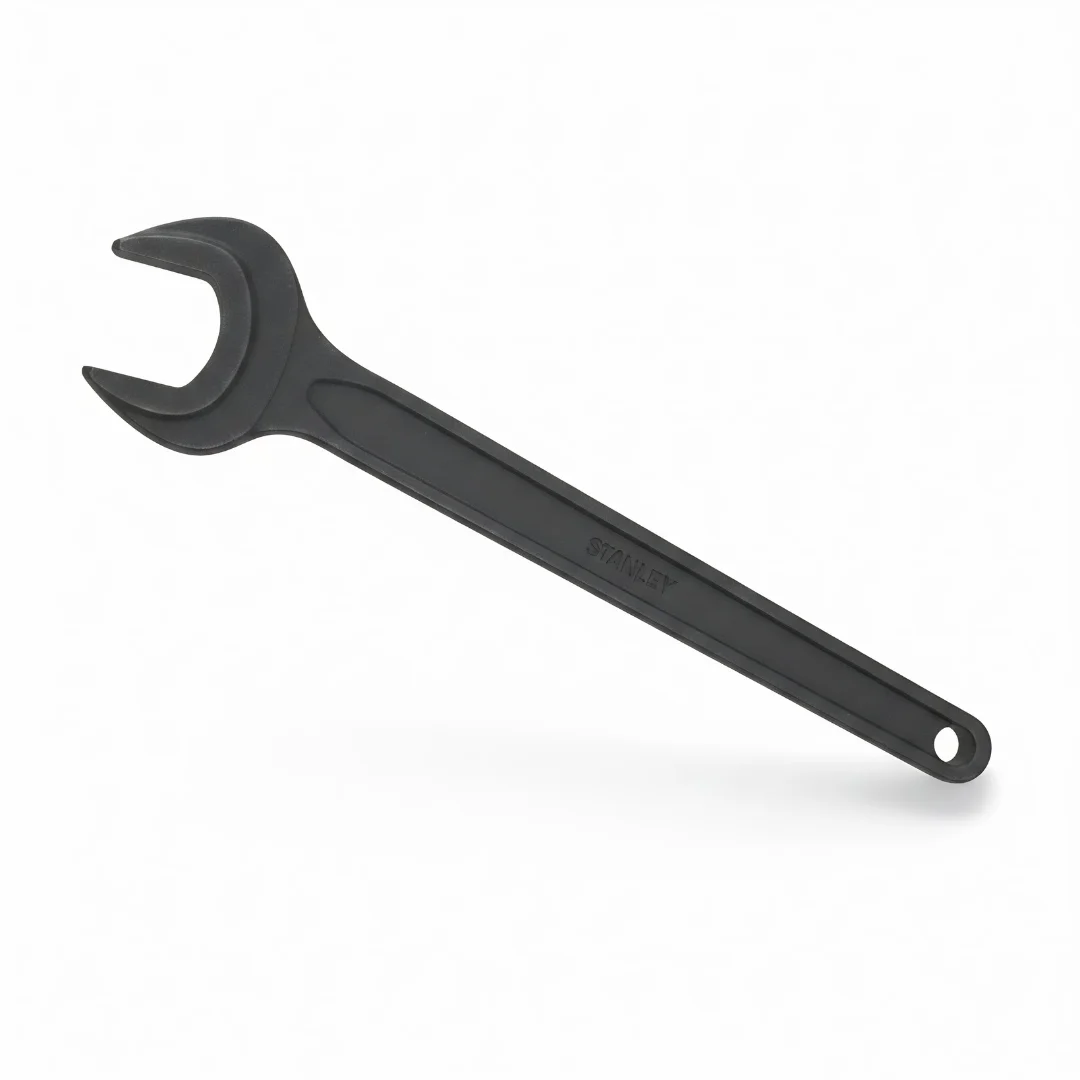
Ring-End Slogging Spanner |
Open-End Striking Spanner |
Hydraulic Torque Wrench |
|
Torque Generation |
Hammer impact |
Hammer impact |
Hydraulic pressure |
|
Bolt Engagement |
Full ring grip |
Partial grip |
Socket interface |
|
Slippage Risk |
Low |
Higher |
Minimal |
|
Precision Torque Control |
No |
No |
Yes |
|
Typical Application |
Heavy maintenance |
Structural bolting |
Controlled torque tightening |
Selection Checklist
Before purchasing, confirm the following:
Correct bolt size is 50 mm
Tool required for hammer impact operation
Work area allows hammer swing clearance
Application involves large industrial fasteners
Ring-end design preferred for secure bolt engagement
No requirement for precision torque measurement
This checklist helps validate tool suitability before procurement.
High-Intent FAQs
What is the difference between a slogging spanner and a normal spanner?
A slogging spanner is designed for hammer impact operation. It has a reinforced striking end that allows the operator to apply rotational torque using hammer blows, which is not possible with standard spanners.
When should a 50 mm slogging spanner be used?
A 50 mm slogging spanner is used for tightening or loosening large industrial bolts or nuts with a 50 mm hex dimension, typically found in heavy equipment, structural assemblies, and power plant installations.
Can a slogging spanner replace a torque wrench?
No. Slogging spanners apply uncontrolled impact torque and are not suitable where precise torque specifications must be followed.
Why is a ring-end design used in slogging spanners?
The ring-end design provides full engagement with the bolt head, reducing the risk of slippage during hammer strikes and improving torque transmission.
What hammer weight is typically used with slogging spanners?
Industrial maintenance teams commonly use hammers between 2 kg and 5 kg, depending on the bolt size and required torque.
How do I confirm the correct spanner size?
Measure the flat-to-flat dimension of the bolt or nut. The selected slogging spanner must match that dimension exactly.
Technical Configuration Overview
Technical Specifications
Tool Identification
|
Parameter |
Specification |
|
Brand |
STANLEY |
|
Model Number |
STMT96965 |
|
Tool Type |
Ring-End Slogging Spanner |
|
Size |
50 mm |
|
Application |
Heavy impact tightening and loosening |
|
Operation Method |
Hammer striking |
Dimensional Characteristics
|
Parameter |
Typical Range |
|
Nominal Ring Size |
50 mm |
|
Head Type |
Closed ring |
|
Handle Type |
Straight impact handle |
|
Striking Surface |
Reinforced striking end |
|
Design Standard |
Industrial striking spanner design |
Construction Characteristics
|
Feature |
Function |
|
Drop-forged steel construction |
Provides structural strength under impact |
|
Ring head design |
Maintains secure engagement with bolt |
|
Reinforced striking end |
Withstands repeated hammer blows |
|
Industrial finish |
Protects tool surface from corrosion |







Customer reviews