



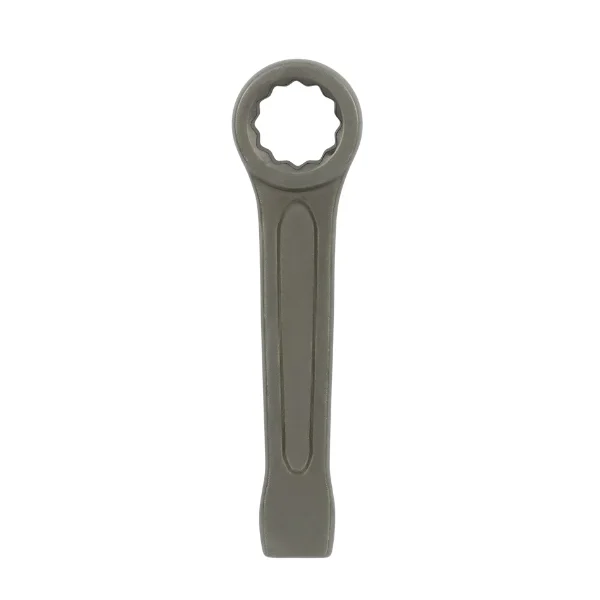
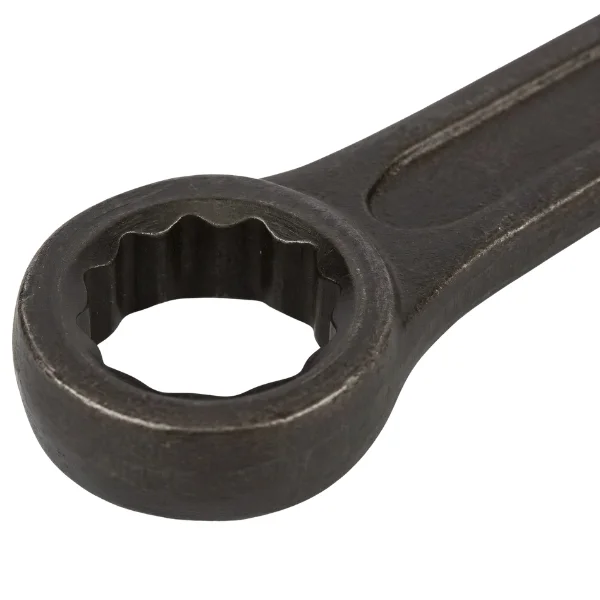
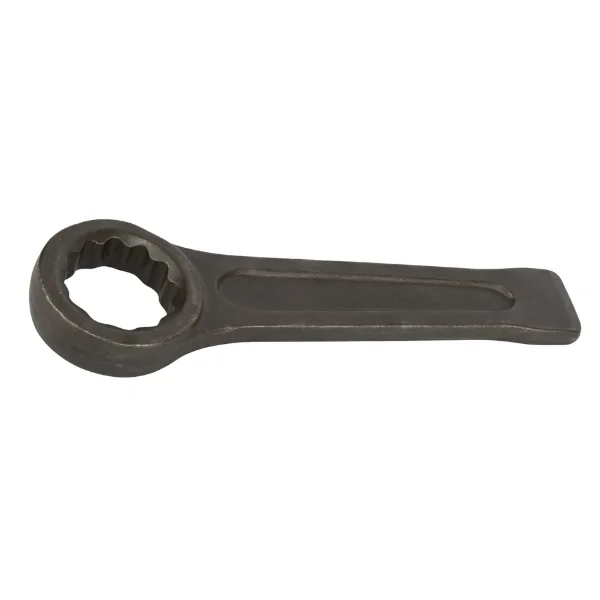
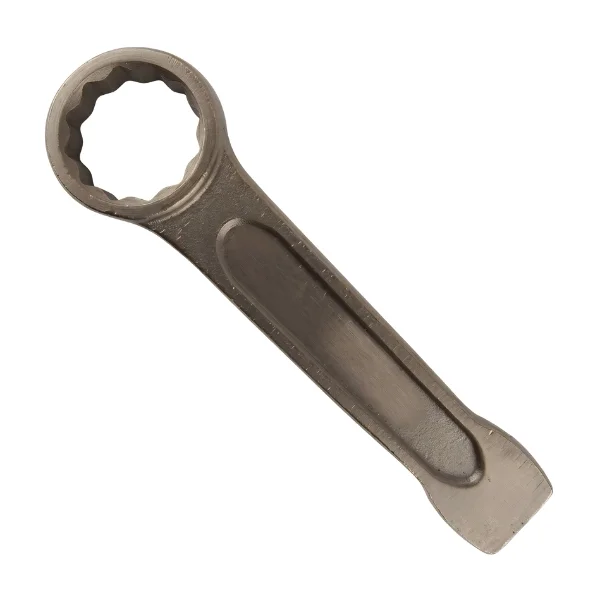


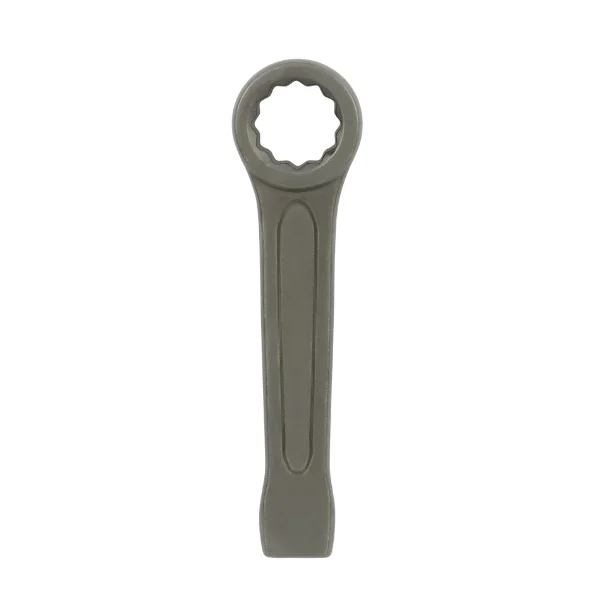
The closed ring head engages the nut completely while the extended striking end allows controlled hammer blows, enabling high torque transmission during equipment maintenance, heavy assembly, and plant shutdown operations.
Application Context & Use Cases
Large ring-end slogging spanners are used where standard hand torque cannot overcome fastener resistance.
Industrial Maintenance Operations
Typical maintenance tasks include:
Removing seized flange bolts
Disassembling heavy mechanical housings
Loosening large anchor bolts
Equipment overhaul during shutdown periods
These tools are commonly used in:
Power plants
Steel manufacturing units
Cement plants
Mining operations
Oil and gas facilities
Shipyards
Structural Assembly Applications
Large spanners are also required for assembling heavy equipment such as:
Turbine housings
Structural steel connections
Pressure vessel assemblies
Mining machine components
Hammer-driven torque allows technicians to apply force where long lever arms are impractical.
Selection Guidance
Selecting the correct slogging spanner requires evaluation of both fastener size and working conditions.
Fastener Size Matching
The ring diameter must match the nut size precisely.
Incorrect sizing leads to:
Slippage
Fastener rounding
Tool deformation
Bolt Torque Requirements
Hammer-driven spanners are used when:
Torque requirement exceeds manual leverage
Fasteners are seized or corroded
Access limits long breaker bars
Workspace Conditions
Consider:
Access around the fastener
Swing space for hammer strikes
Clearance for ring placement
For large industrial bolts (above ~90 mm), slogging spanners provide a controlled impact torque method.
Capacity & Torque Logic (Real-World Example)
Torque produced by a striking spanner depends on:
Hammer mass
Strike velocity
Handle length
Number of strikes
Example Scenario
Flange bolt size: M90
Nut size: ~95 mm
Maintenance technician uses:
4–5 kg sledge hammer
95 mm slogging spanner
Each hammer strike transfers rotational force through the spanner head.
Approximate torque achieved through impact can exceed manual torque capacity of standard wrenches, enabling removal of seized bolts.
This approach is commonly used during:
Refinery flange maintenance
Turbine servicing
Heavy equipment overhaul
Failure Conditions & Misuse Risks
Improper use can damage tools or create safety hazards.
Common Failure Causes
Incorrect Hammer Type
Using hardened steel hammers can cause:
Metal chipping
Tool head damage
Improper Fastener Fit
Oversized or undersized fit leads to:
Rounding of nut edges
Loss of torque transfer
Side Impact
Striking the tool at an angle creates:
Bending stress
Shaft distortion
Safety Considerations
Technicians should ensure:
Stable stance during impact
Correct hammer weight
Proper eye protection
Impact tools must always be used under controlled striking conditions.
Material & Compatibility Table
Tool Material Characteristics
|
Property |
Benefit |
|
Forged alloy steel |
High structural strength |
|
Heat treatment |
Resistance to deformation |
|
Impact-resistant body |
Suitable for hammer strikes |
|
Closed ring design |
Full nut engagement |
Fastener Compatibility
|
Fastener Type |
Compatibility |
|
Hex nuts |
Fully compatible |
|
Heavy structural bolts |
Compatible |
|
Flange bolts |
Compatible |
|
Square nuts |
Not recommended |
The ring profile is designed specifically for hexagonal fasteners.
Operational Handling & Installation Considerations
Tool Placement
The ring head must fully seat on the nut before striking.
Partial seating may cause:
Slippage
Fastener damage
Hammer Position
The striking surface is designed for direct hammer impact.
Operators should strike the flat striking end, not the shaft side.
Working Space Requirements
Allow adequate space for:
Hammer swing
Operator movement
Tool repositioning
Restricted spaces may require alternate torque tools.
Commercial Clarity
As a Pan-India industrial tool supplier, procurement clarity is maintained for industrial buyers.
Lead Time
Stock availability varies by model and quantity.
Typical dispatch timelines:
Ready stock items: 24–72 hours
Bulk procurement: as per order confirmation
Dispatch Capability
Nationwide dispatch supported across:
Manufacturing plants
EPC project sites
Maintenance facilities
Minimum Order Quantity
Industrial buyers may procure:
Single unit
Multiple units for maintenance toolkits
Customization
This model is a standard manufactured tool.
Customization is not applicable.
Compliance & Certification
Product manufactured under established industrial tooling standards by STANLEY.
Tender Compatibility
Supplies may support:
Industrial procurement orders
EPC project requirements
Maintenance supply tenders
Buyers typically reference model numbers during tender submissions.
Procurement Process
Industrial buyers typically follow a structured enquiry process.
Information Required for Enquiry
Provide the following details:
Product model number
Quantity required
Delivery location
Required dispatch timeline
Procurement type (maintenance / project / tender)
Procurement Flow
Buyer submits enquiry
Supplier confirms product availability
Quotation issued with delivery terms
Purchase order confirmation
Dispatch arranged
This process aligns with standard industrial MRO procurement practices.
Comparison Table — Common Alternatives
|
Tool Type |
Torque Capacity |
Use Case |
Limitation |
|
Slogging Spanner |
High impact torque |
Large seized fasteners |
Requires hammer |
|
Breaker Bar |
Moderate torque |
Long leverage tightening |
Limited on large bolts |
|
Hydraulic Torque Wrench |
Very high torque |
Controlled torque tightening |
Higher equipment cost |
|
Impact Wrench |
Medium–high torque |
Fast assembly work |
Requires compressed air or power |
Slogging spanners remain widely used for manual heavy maintenance operations.
Selection Checklist
Before purchasing, confirm the following:
Fastener size matches 95 mm ring diameter
Tool required for hammer-driven torque
Adequate swing space available
Operator trained for striking tools
Tool required for industrial maintenance tasks
This checklist helps prevent incorrect tool procurement.
High-Intent FAQs
What is the main purpose of a 95 mm slogging spanner?
It is used to loosen or tighten large industrial fasteners by transmitting torque through hammer strikes applied to the striking end of the spanner.
When should a slogging spanner be used instead of a torque wrench?
Slogging spanners are used when fasteners are seized or require impact force rather than calibrated torque.
Is this tool suitable for hydraulic bolt tightening?
No. Hydraulic tightening applications require torque or tensioning equipment rather than manual striking tools.
Can this spanner be used for structural steel bolts?
Yes. It is commonly used for loosening or tightening heavy structural bolts during installation or maintenance.
What hammer weight is typically used with large slogging spanners?
Maintenance teams commonly use 4–5 kg sledge hammers, depending on the bolt size and working conditions.
Does the tool require calibration?
No. Slogging spanners are impact tools and do not require torque calibration.
Is the ring-end design safer than open-end striking tools?
Yes. The closed ring provides full contact with the nut, reducing the risk of slippage during hammer impact.
Technical SpecificationsProduct Identification
|
Parameter |
Specification |
|
Brand |
STANLEY |
|
Model Number |
STMT96974 |
|
Tool Type |
Ring-End Slogging Spanner |
|
Nominal Size |
95 mm |
|
Application |
Hammer-driven tightening / loosening |
|
Construction |
Forged alloy steel |
|
Surface Finish |
Corrosion-resistant finish |
|
Impact Type |
Manual hammer strike |
Dimensional Characteristics
|
Dimension |
Description |
|
Ring Diameter |
95 mm |
|
Head Type |
Closed ring striking head |
|
Handle Type |
Straight striking shaft |
|
Load Type |
High impact torque |
|
Force Application |
Hammer impact |
The closed ring design ensures full nut engagement, reducing slip risk during hammer impact.







Customer reviews