



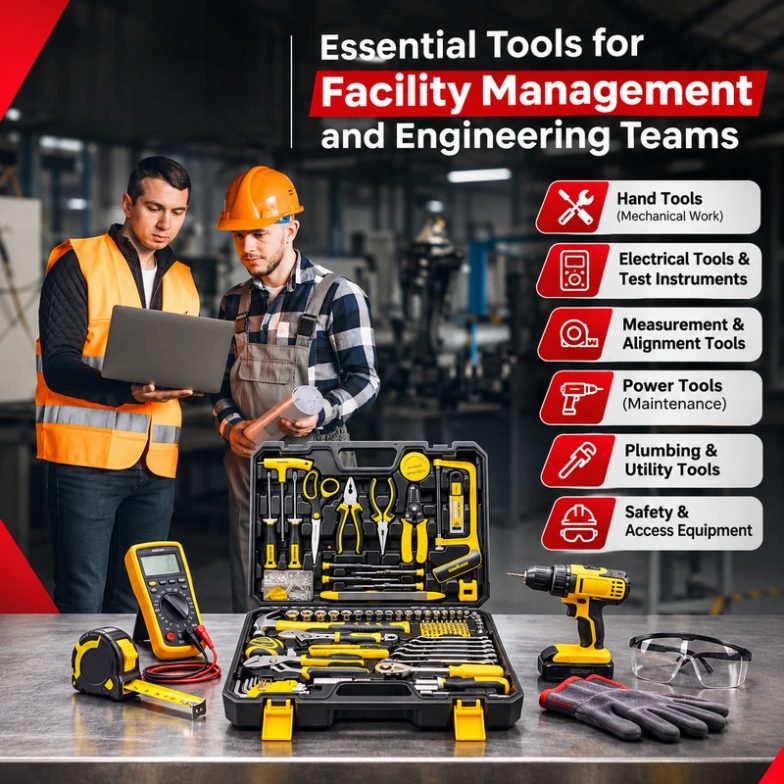
Essential Tools for Facility Management and Engineering Teams
Facility-management and engineering teams need a controlled tool system, not a random collection of products. The right kit should support routine inspection, preventive maintenance, breakdown response, electrical checks, mechanical repair, measurement, safe access and documentation across the actual assets in the facility.
A reliable tool programme starts with tasks and risk. Teams should map equipment, identify permitted work, select tools with suitable specifications, assign ownership, control calibration and inspection, and replenish critical items before shortages interrupt service. This guide provides a practical framework for offices, commercial buildings, warehouses, hospitals, campuses and industrial facilities.
Build the Tool List from Asset Criticality
Start with an asset register: electrical panels, motors, pumps, HVAC equipment, plumbing, fire systems, doors, lighting, controls, material-handling equipment and building fabric. For each asset, list routine inspections, adjustments, consumables, isolation requirements and common failure tasks. Separate work that in-house staff may perform from work reserved for qualified specialists.
Criticality changes the tool requirement. A loose door closer and a failing chilled-water pump do not carry the same service consequence. Identify response-time targets and the minimum tools needed to make the area safe, diagnose the issue and complete an authorised repair. Keep contractor-only tasks out of general tool kits.
Create Four Layers of Tooling
| Layer | Purpose | Typical control |
|---|---|---|
| Personal issue | Frequently used basic tools | Named issue and periodic condition check |
| Team kit | Shared trade-specific work | Checkout, completeness and replenishment |
| Central store | Specialist or infrequent tools | Authorised issue and return inspection |
| Emergency kit | Rapid isolation and first response | Sealed inventory and shift checks |
This layered model reduces duplication without making technicians search for basic tools. It also prevents expensive instruments from circulating without control. Define where each item lives, who can use it and what must be checked before return.
Core Hand Tools for Mechanical Work
A mechanical maintenance kit commonly includes combination spanners, adjustable wrenches, socket and ratchet sets, hex and Torx keys, screwdrivers, pliers, cutters, hammers, punches, files and suitable pulling or gripping tools. Select drive sizes, profiles and ranges that match the facility’s fasteners and equipment.
Use the live Indus MegaMart hand-tool selection guide to map tool functions, then standardise common sizes. Avoid universal kits filled with rarely used pieces while a critical spanner or socket remains unavailable.
Inspect jaws, insulation where relevant, handles, ratchets and striking faces. Remove mushroomed chisels, cracked handles, distorted sockets and tools that slip under load. Do not modify a tool to create leverage or access it was not designed to provide.
Electrical Tools and Test Instruments
Electrical work requires competence, approved procedures and instruments rated for the system and environment. Typical diagnostic tools may include a digital multimeter, clamp meter, insulation-resistance tester, voltage detector, earth tester and phase-sequence instrument. The exact set depends on authorised tasks and system voltage.
Check measurement category, voltage and current range, probe condition, fuse specification, ingress protection and applicable standards. Verify calibration or functional checks at defined intervals. A display that powers on does not prove the instrument is safe or accurate. Leads, probes and accessories need the same inspection discipline as the meter.
Browse the site’s test and measurement categories by required function and specification. The category page is a sourcing aid; the facility’s electrical safety procedure and competent-person assessment must decide what may be used.
Measurement and Alignment Tools
Facility work often fails because teams estimate rather than measure. Useful items can include measuring tapes, steel rules, spirit levels, squares, callipers, feeler gauges, pressure gauges, infrared thermometers and alignment tools. Define acceptable accuracy for the task before choosing an instrument.
Keep precision tools protected from impact, contamination and unauthorised adjustment. Record calibration status where measurements influence safety, acceptance or compliance. Label instruments with identification and due date, and quarantine anything overdue, damaged or producing implausible readings.
Power Tools for Controlled Maintenance
Drills, rotary hammers, impact drivers, grinders, cutters, sanders and cordless tools can improve response time, but they add hazards and consumable requirements. Select power, speed, chuck or disc size, duty rating, guarding and dust-control arrangements for the actual application.
Maintain batteries, chargers, guards, cables and accessories as part of the tool system. Match bits, blades and discs to the machine rating and material. Record pre-use checks and prevent improvised use. Work permits, isolation, hot-work controls and PPE remain necessary where the task requires them.
Plumbing and Utility Maintenance Tools
Plumbing response kits may include pipe wrenches, water-pump pliers, basin tools, tube cutters, deburring tools, drain equipment, pressure-test accessories and approved leak-detection tools. Add consumables only where storage life and compatibility can be controlled.
Separate tools used on potable-water systems from contaminated services where hygiene requires it. Label kits for their system and clean them after use. Before opening a line, confirm isolation, residual pressure, fluid hazard, drainage and the effect on connected occupants or processes.
HVAC and Refrigeration Support Tools
HVAC teams may need temperature and humidity instruments, airflow measurement, pressure tools, electrical diagnostics, fin-cleaning tools, vacuum and refrigerant-service equipment. Refrigerant work should be limited to trained personnel using approved recovery and handling procedures.
Select instruments for the expected temperature, pressure and fluid. Keep hoses, manifolds and sensors clean and capped. Trend readings rather than relying on a single measurement; air temperature without airflow, or pressure without operating context, can lead to poor diagnosis.
Material Handling and Access Equipment
Hand trucks, platform trolleys, pallet trucks, ladders and access platforms are tools with significant load and safety implications. Confirm rated capacity, wheel condition, brake function, stability, floor compatibility and the route before movement. Do not treat a trolley or ladder as an unregistered convenience item.
Inspect access equipment on a formal schedule and before use. Use the right height and configuration instead of standing on boxes or furniture. For lifting and powered access, follow the applicable inspection, training and permit requirements.
PPE Supports the Task but Does Not Replace Control
PPE selection follows the hazard assessment. Common facility items may include eye protection, gloves, hearing protection, safety footwear, helmets, respiratory protection and arc-rated equipment for authorised electrical work. Size, compatibility, condition and storage matter.
Do not buy PPE as a generic bundle and assume it covers every task. Chemical, electrical, thermal, impact and dust hazards can require different materials and ratings. Engineering controls, isolation and safe procedures remain the first line of protection.
Tool Storage and Visual Control
Use cabinets, foam layouts, labelled drawers, shadow boards, portable bags and sealed emergency kits according to the work pattern. Storage should protect tools from moisture, dust, impact and unauthorised use. Heavy items belong at safe lifting heights, while precision instruments need dedicated cases.
A visual system should reveal missing items quickly. Number shared tools and kits, record issue and return, and keep a completeness checklist. Store batteries and chemicals according to manufacturer instructions and fire-safety requirements.
Control Calibration, Inspection and Repair
Create a register with tool ID, description, location, owner, risk class, inspection interval, calibration requirement, last action, next due date and status. Use risk-based intervals supported by manufacturer guidance and operating experience. High-use torque tools or safety-critical meters may need tighter control than ordinary hand tools.
Define outcomes: serviceable, restricted, quarantine, repair or scrap. A coloured sticker without a traceable record is weak evidence. After repair or adjustment, verify function before release. Preserve certificates for calibrated instruments and investigate out-of-tolerance results that may affect earlier work.
Standardise Procurement without Over-Specifying
A procurement request should state task, dimensions, capacity, range, accuracy, duty, environment, compatibility, accessories, quantity, documentation and delivery need. Where a model is mandatory for standardisation, name it; otherwise describe performance so equivalent options can be evaluated fairly.
Indus MegaMart presents industrial product categories covering power tools, hand tools, material handling, test instruments, measuring tools and automation. Procurement teams can use these categories to structure enquiries, then confirm exact model availability and specifications with the supplier.
Avoid Common Tool-Management Failures
- Buying a large kit without mapping the facility’s fasteners and tasks.
- Sharing safety-critical instruments without ownership or calibration control.
- Keeping damaged tools because a replacement is not immediately available.
- Allowing accessories, batteries, leads and consumables to escape inspection.
- Using household-grade products for repeated industrial duty without assessment.
- Ignoring storage, checkout and replenishment after the initial purchase.
Facility Tool Audit Checklist
- Confirm the asset list, authorised tasks and critical response needs.
- Map each task to tool, accessory, PPE and competence requirements.
- Identify duplicate, missing, damaged and obsolete items.
- Verify inspection, calibration, storage and checkout records.
- Set minimum stock and replenishment triggers for critical items.
- Review the list after incidents, asset changes and major projects.
Control Consumables, Accessories and Spare Items
A tool is often unusable because the correct blade, bit, battery, lead, fuse, abrasive, socket adaptor or test accessory is missing. Add these items to the same task map. Define compatible models, safe storage, shelf life, reorder level and replacement responsibility. Avoid unapproved substitutions that change speed rating, insulation, fit or measurement performance.
Store consumables by type and condition. Segregate damaged, contaminated and expired items. For frequently used products, record issue by quantity rather than by individual serial number; for safety-critical accessories, keep traceable inspection and replacement evidence. Review consumption trends to identify abnormal use, poor technique or repeated equipment faults.
Design Role-Based Kits
An electrician, HVAC technician, plumber, general handyman and shift engineer do not need identical kits. Build a common core, then add trade-specific modules. This improves portability and reduces the temptation to use an unsuitable tool because the correct one is stored elsewhere. Label modules clearly and keep a standard layout across shifts.
Match issue rights to competence. A specialist kit should not circulate as a general toolbox when it contains instruments or equipment requiring training. At shift handover, verify completeness, defects and open jobs. When a tool remains at a worksite, record its location so the next team does not report it lost or buy a duplicate.
Use Digital Inventory and Meaningful Metrics
A simple digital register can track issue, return, inspection, calibration, repair and stock. Barcodes or QR labels may reduce typing, but the process must still work during network or device outages. Keep naming consistent and avoid duplicate descriptions for the same item. Link a kit to its contents without losing individual control of high-risk tools.
Useful measures include overdue inspections, calibration compliance, missing-tool rate, repair turnaround, emergency-kit readiness, stock-outs and repeated damage. Do not reward low tool spending if teams compensate with delay or unsafe improvisation. Review trends with supervisors and procurement, then remove obsolete items from active records.
Coordinate Contractors and Loan Tools
Contractors should bring tools suitable for their work unless the contract states otherwise. Before work begins, define inspection evidence, electrical ratings, calibration, access equipment and prohibited items. Facility teams should not casually lend tools that transfer responsibility or leave the site without traceability.
When loan equipment is justified, use a formal handover with condition, accessories, return time and authorised user. Inspect it on return and record any incident. Contractor tools that are visibly damaged, modified or unsuitable should be removed from service through the site control process rather than ignored because they are not company-owned.
Compare Lifecycle Value, Not Only Purchase Price
Evaluate durability, ergonomics, repeat availability, warranty, service support, calibration access, spare accessories and total downtime. A low initial price can become expensive if a tool fails during critical work or uses proprietary consumables that cannot be sourced. Standardisation can simplify training and stocking, but it should not lock the facility into an unsuitable specification.
Trial unfamiliar products under controlled conditions before large purchase. Gather feedback from competent users on grip, balance, visibility, setup and actual task fit. Document the accepted specification so future substitutions are reviewed against performance rather than a brand name alone.
Plan Training and Competence for Tool Use
Ownership of a tool does not establish competence. Define which items require induction, supervised practice, formal authorisation or refresher training. Cover correct setup, limitations, inspection, safe force, accessory changes, isolation and emergency response. Keep training practical and linked to facility tasks rather than a generic product demonstration.
Supervisors should observe use during real work and correct unsafe shortcuts early. Include new starters, temporary staff and night shifts. When the tool model, process or hazard changes, review whether existing training remains adequate. Record competence decisions separately from attendance at a briefing.
Create a Ninety-Day Improvement Plan
In the first month, complete the asset-to-task map and quarantine damaged or overdue equipment. In the second month, standardise personal and team kits, reconcile inventory and set inspection or calibration dates. In the third month, establish replenishment levels, review contractor controls and report the first management metrics.
Prioritise actions that remove immediate safety and service risks. Do not wait for a perfect software system before labelling kits and assigning owners. A simple controlled register used consistently is more valuable than a sophisticated platform with incomplete records.
At the end of ninety days, sample several completed jobs and check whether technicians had the correct tools, whether records were updated, and whether delays or unsafe improvisations reduced. Use the evidence to revise kit contents, minimum stock and training priorities for the next quarter.
Record the approved changes and assign owners and dates for remaining gaps.
Frequently Asked Questions
1. What tools should every facility technician carry?
A basic set usually includes correctly sized screwdrivers, pliers, cutters, spanners, sockets, hex keys, a measuring tape and approved task-specific items. The final list must follow authorised work.
2. Should every technician receive a complete tool kit?
Issue frequently used personal tools, then keep specialist and expensive items in controlled team or central stores. This balances access with accountability.
3. How often should tools be inspected?
Use risk, frequency, environment, manufacturer guidance and experience. Pre-use checks are important, with documented periodic inspections for controlled items.
4. Which electrical meter is most useful?
No single meter fits every task. Multimeters and clamp meters cover different needs; system ratings, measurement category and authorised work determine selection.
5. Do all measuring tools need calibration?
Not necessarily. Calibration is important when accuracy affects safety, compliance, acceptance or technical decisions. Define the requirement in the register.
6. How should damaged tools be handled?
Remove and label them immediately, place them in quarantine and decide whether approved repair, verification or disposal is appropriate.
7. Are cordless tools better for facilities?
They improve portability but require battery, charger and storage control. Corded tools may suit sustained work. Choose according to duty, access and safety.
8. What belongs in an emergency maintenance kit?
Only items needed to make common high-impact failures safe and support authorised first response. Keep the kit sealed, checked and clearly located.
9. How can tool loss be reduced?
Use numbered tools, visual storage, named issue, kit checklists and return inspections. Make responsibility clear without creating slow bureaucracy.
10. What information should a tool purchase request include?
State application, size or range, duty, environment, ratings, accuracy, accessories, quantity, documentation and required delivery.
11. Can PPE replace safer tools or isolation?
No. PPE is one layer. Correct tools, isolation, engineering controls, permits and competent work remain essential.
12. When should the tool list be reviewed?
At least periodically and after new assets, incidents, audit findings, repeated shortages, process changes or major maintenance work.
Equip Faster, Safer Facility Response with a Controlled Tool System
Turn the asset and task map into a standardised tool list, then review relevant Indus MegaMart categories and the company’s industrial sourcing approach. For a project or MRO enquiry, use the Indus MegaMart contact page with your tool types, specifications, quantities, preferred brands, site location and delivery timeline so the response can be matched to the real requirement.