



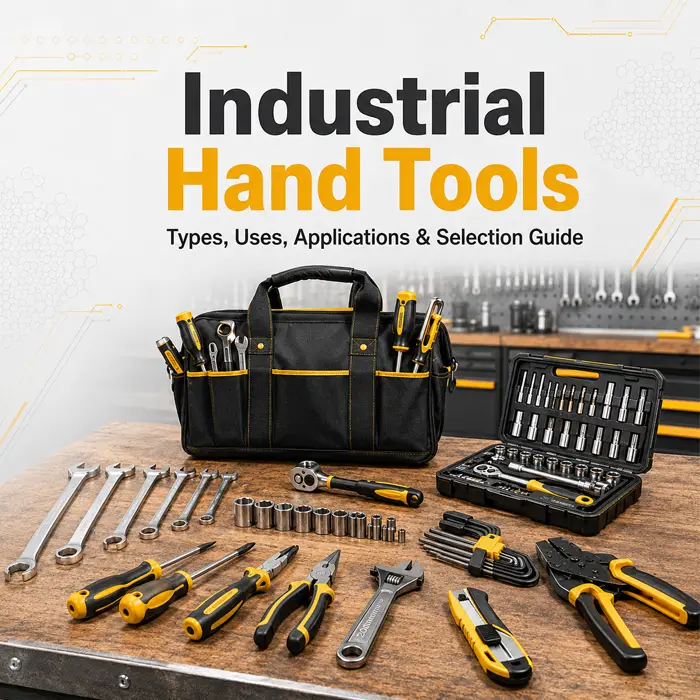
Industrial Hand Tools: Types, Uses, Applications & Selection Guide
Industrial hand tools remain an essential part of everyday work in factories, workshops, construction sites and maintenance facilities. Even where automated machinery and power tools handle demanding operations, technicians still rely on hand tools for tasks that require direct control, accessibility and precision.
From tightening a machine fastener and gripping a component to cutting wire, holding a workpiece or making an adjustment during maintenance, the right tool can make routine work simpler and more controlled.
However, choosing professional tools involves more than finding something that fits the job. Tool type, size, material, compatibility, ergonomics, working environment and frequency of use can all influence suitability.
This guide explains the major types of industrial hand tools, their uses and applications, along with practical considerations for maintenance teams, technicians and industrial buyers selecting tools for professional work.
What Are Industrial Hand Tools?
Industrial hand tools are manually operated tools used for assembly, installation, maintenance, repair, fabrication, construction and equipment servicing. Unlike power tools, they primarily rely on force applied by the operator rather than an electric motor, battery or pneumatic system.
Common examples include:
- Spanners and wrenches
- Sockets and ratchets
- Screwdrivers and bits
- Hex and Torx keys
- Pliers and crimping tools
- Cutting tools
- Hammers and striking tools
- Clamps and vices
- Finishing tools
- Speciality tools
- Tool kits and sets
Professional users may operate these tools repeatedly and under more demanding conditions than occasional household users. This makes correct sizing, construction, durability, grip and application compatibility important selection factors.
What Are Industrial Hand Tools Used For?
Industrial hand tools are primarily used for fastening, gripping, cutting, striking, crimping, holding, fitting, adjustment and finishing operations.
Here is a quick way to understand which tools are generally associated with each function:
Required Task |
Common Hand Tools |
|
Tightening and loosening |
Spanners, wrenches, sockets, ratchets |
|
Screw fastening |
Screwdrivers and bits |
|
Recessed fasteners |
Hex and Torx keys |
|
Gripping and bending |
Pliers |
|
Crimping |
Crimping tools |
|
Cutting and trimming |
Cutters and cutting pliers |
|
Striking and fitting |
Hammers and striking tools |
|
Holding workpieces |
Clamps and vices |
|
Finishing |
Finishing tools |
|
General maintenance |
Tool kits and sets |
|
Specialized operations |
Speciality tools |
Starting with the required function is often more useful than selecting tools simply by category.
Why Are Hand Tools Important in Industrial Work?
Automation has transformed industrial production, but it has not removed the need for manual intervention.
Maintenance technicians still need to open equipment, remove fasteners, adjust components and reinstall assemblies. Electricians need tools for wiring and terminal work. Fabricators need to hold, fit and prepare components. Contractors require portable tools for installation and site work.
Industrial hand tools are therefore widely used for:
- Machinery assembly and installation
- Preventive and corrective maintenance
- Equipment repair and servicing
- Fabrication and metalworking
- Electrical installation
- Construction and site work
- Automotive maintenance
- Workshop operations
- MRO activities
Their portability is another advantage. Many hand tools can be carried directly to the equipment and used without requiring batteries, electrical connections or compressed-air supplies.
Major Types of Industrial Hand Tools and Their Applications
Understanding the main categories can help buyers build a tool inventory around actual maintenance and operational requirements.
1. Tool Kits & Sets
Tool kits and hand tool sets combine multiple tools in an organized package. Depending on the set, this may include screwdrivers, sockets, ratchets, pliers, spanners, hex keys and other commonly required items.
They are particularly useful for:
- General machinery maintenance
- Field servicing
- Equipment installation
- Workshop repairs
- Assembly
- On-site troubleshooting
A professional tool kit can also make it easier to standardize the basic tools issued to technicians.
However, more pieces do not automatically mean a better kit. Buyers should check whether the included tools and sizes match the work their technicians actually perform.
2. Spanners & Wrenches
Spanners and wrenches are fundamental mechanical hand tools used for tightening, loosening and holding compatible nuts and bolts.
Typical applications include machinery assembly, mechanical maintenance, automotive servicing, structural fitting and equipment installation.
Correct sizing matters. A poorly fitting wrench can slip or damage the fastener profile.
Where technicians encounter several fastener dimensions, a spanner or wrench set can provide a practical range of commonly required sizes.
3. Sockets & Ratchets
Sockets fit over compatible fasteners, while a ratchet allows repeated turning without removing the tool after every movement.
This makes socket and ratchet tools particularly useful for repetitive fastening and maintenance operations.
They are commonly used for machinery assembly, automotive repair, equipment servicing and mechanical maintenance.
When choosing a socket set, consider:
- Socket sizes
- Drive size
- Fastener compatibility
- Accessibility
- Extensions required
- Application demands
Extensions can be especially useful when a fastener is recessed or difficult to reach with a conventional spanner.
4. Screwdrivers & Bits
Industrial screwdrivers are used to install, tighten and remove screws across machinery, electrical equipment, panels, fixtures and assemblies.
The screwdriver tip must correspond to the screw profile and size. A poor match can result in slipping or damage to the screw head.
A screwdriver and bit set can be useful where technicians encounter multiple profiles during routine maintenance.
Handle comfort also becomes important when screwdrivers are used repeatedly throughout the working day.
5. Hex & Torx Keys
Hex keys, commonly called Allen keys, and Torx keys are designed for corresponding recessed fasteners.
They are frequently used in machinery, equipment assemblies, automotive systems, fixtures and industrial components.
A hex key set or Torx key set provides multiple sizes, but technicians should always use the closest correct fit. An incorrectly sized key can damage the recess and make subsequent removal difficult.
6. Pliers & Crimping Tools
Pliers are versatile tools used for gripping, bending, positioning, pulling and, depending on the design, cutting.
Different types serve different purposes. Combination pliers support general gripping and cutting, while long-nose designs are useful when working with smaller components or confined spaces.
Crimping tools perform a more specific function. They create mechanical connections between compatible conductors, terminals and connectors.
They are widely used in electrical installation, panel building, equipment wiring and maintenance. Because connection quality matters, the crimping tool should match the terminal or connector being used.
7. Cutting Tools
Hand cutting tools support jobs such as wire cutting, cable preparation, trimming, packaging, installation and fabrication work.
Tool selection should be based on:
- Material being cut
- Material thickness
- Cutting capacity
- Blade or edge type
- Frequency of use
Using a light-duty cutter on material beyond its intended capacity can reduce control and damage the tool.
8. Striking & Demolition Tools
Hammers and other striking tools transfer manual impact to a component or workpiece.
They can support fitting, alignment, assembly, fabrication, construction, maintenance and demolition work.
The appropriate tool depends on the required impact and the material being struck. Head type, head weight, handle construction and application should therefore be considered before selection.
9. Clamps & Vices
Clamps and vices help keep components stable during fabrication, cutting, fitting, assembly and repair.
Industrial clamps provide temporary workholding, whereas a bench vice offers a fixed holding arrangement for workshop tasks such as filing, cutting and component preparation.
The objective should be to secure the workpiece without applying inappropriate force or damaging its surface.
10. Speciality Tools
Some maintenance jobs require tools designed for a particular component, profile or servicing procedure.
Speciality tools become useful when:
- Access is restricted
- A standard tool cannot engage correctly
- Equipment requires a particular profile
- A specific installation or removal procedure is involved
Using the correct speciality tool can be preferable to improvising with a general-purpose tool that was never designed for the operation.
11. Finishing Tools
Finishing tools support surface preparation, edge preparation, deburring and other final-stage fabrication or repair work.
Selection depends on the workpiece material and required finish. Buyers should therefore consider material compatibility and the amount of material that needs to be removed or refined.
Industrial Applications of Hand Tools
The same hand tool may serve different purposes depending on the industry and equipment involved.
Machinery Assembly and Installation
Spanners, sockets, ratchets, screwdrivers and hex keys are commonly used to assemble and adjust machine components, fixtures and fasteners.
Preventive and Corrective Maintenance
Hand tools for industrial maintenance allow technicians to access equipment, inspect components, perform adjustments and replace worn parts.
Fabrication and Metalworking
Fabrication teams use pliers, clamps, vices, cutting tools, hammers and finishing tools alongside powered machinery.
Electrical Installation and Maintenance
Screwdrivers, pliers, cutters and crimping tools are commonly used for wiring, terminals and equipment maintenance. Where electrical hazards exist, tools specifically designed and rated for the intended environment may be required.
Construction and Site Work
Portable hand tools support fastening, fitting, cutting, adjustment and installation activities across construction projects.
Automotive and Equipment Servicing
Sockets, ratchets, spanners, screwdrivers, pliers and speciality tools are widely used to dismantle, inspect, repair and reassemble vehicles and equipment.
MRO Operations
Maintenance, Repair and Operations teams generally require a broad selection because their responsibilities may extend across machines, utilities, infrastructure and facility equipment.
Which Industries Use Hand Tools?
Industrial hand tools are widely used across:
- Manufacturing
- Engineering
- Automotive
- Construction
- Infrastructure
- Fabrication
- Electrical installation
- Utilities
- Warehousing
- Facility management
- Machinery servicing
- Industrial MRO
There is no universal tool list for every industry. A fabrication shop, electrical maintenance team and mechanical service department may all use hand tools but require very different combinations.
Hand Tools vs Power Tools: What's the Difference?
Hand tools and power tools frequently complement one another rather than compete.
Factor |
Hand Tools |
Power Tools |
|
Power source |
Manual force |
Battery, electricity, air or another source |
|
Control |
Direct manual control |
Depends on tool and operating speed |
|
Speed |
Generally slower |
Faster for many repetitive tasks |
|
Portability |
Usually highly portable |
Depends on battery, power supply and size |
|
Maintenance |
Generally simpler |
May involve motors, batteries and electronics |
|
Confined access |
Often convenient |
Tool dimensions can limit access |
|
Best suited for |
Controlled manual operations |
Faster or more demanding operations |
For example, a technician might use a powered tool for repetitive fastening and then use a hand tool for final adjustment.
Professional workshops therefore commonly maintain both categories.
How to Choose the Right Industrial Hand Tools
The best hand tool is not necessarily the most expensive or the one with the longest feature list. It is the tool that correctly matches the application.
Start With the Task
First identify what needs to be done: fastening, gripping, cutting, holding, crimping, striking or finishing.
This immediately narrows the suitable tool category.
Check Size and Compatibility
Confirm the dimensions and profile of the component or fastener.
This is particularly important for:
- Spanners
- Sockets
- Screwdrivers
- Hex keys
- Torx keys
- Crimping systems
Correct engagement improves control and helps avoid unnecessary fastener damage.
Consider Accessibility
A technically compatible tool may still be inconvenient if there is insufficient room to operate it.
Check whether the job involves recessed fasteners, narrow spaces, awkward angles or restricted movement.
Evaluate Construction and Durability
Tools used every day in a workshop or plant may face substantially more wear than those used occasionally.
For repetitive professional applications, consider construction quality, material, expected tool life and suitability for the intended workload.
Look at Grip and Ergonomics
Because hand tools depend directly on operator input, grip, balance and handle design affect usability.
These factors become more significant during repetitive assembly, maintenance and production-support work.
Consider Frequency of Use
Frequently used tools justify closer attention to durability, fit, ergonomics and replacement availability.
A tool used several times every shift has different procurement requirements from one kept for occasional servicing.
Account for the Working Environment
Consider where the tool will be used: a workshop, production floor, construction site, outdoor location, confined space or electrical environment.
The surrounding conditions can influence the appropriate design and specification.
What Should Procurement Teams Check Before Buying Hand Tools?
Buying tools for an entire plant or maintenance department requires a broader approach than purchasing a single screwdriver or wrench.
Procurement teams should evaluate:
- Application: What work will the tool perform?
- Specifications: Does its size, profile, capacity or drive match the requirement?
- Compatibility: Will it work with the intended equipment or fastener?
- Quantity: How many technicians or workstations require it?
- Frequency: Will the tool be used occasionally or every day?
- Tool set vs individual tool: Is a complete set useful or would individual sizes be more economical?
- Availability: Can commonly required products be sourced again?
- Brand and model: Is standardization required across teams?
- Supplier reliability: Can the supplier support repeat and bulk requirements?
For industrial MRO procurement, consistency matters. Standardizing frequently used tools can simplify replacement, inventory control and technician access.
Individual Hand Tools vs Tool Kits: Which Is Better?
Choose individual tools when replacing a damaged item, adding a frequently used size or purchasing a specialized tool.
Choose tool kits when setting up a new maintenance team, workshop or field-service operation where technicians need access to multiple commonly used tools.
There is also a middle option: application-specific sets such as socket sets, spanner sets, screwdriver sets, pliers sets and hex key sets.
The best choice depends on actual usage—not simply the number of tools included in the package.
Essential Safety Practices for Industrial Hand Tools
Hand tools do not have motors, but incorrect use can still result in injuries, tool failure and component damage.
Operators should:
- Use the correct tool and size for the task.
- Inspect tools for damaged handles, jaws, tips, cutting edges or striking surfaces.
- Remove unsuitable or damaged tools from service.
- Avoid using tools as improvised levers or striking devices.
- Maintain appropriate grip and working position.
- Use task-appropriate PPE according to workplace procedures.
- Store tools securely and keep sets organized.
- Replace worn tools before their condition compromises correct use.
Electrical work deserves particular attention. An ordinary screwdriver or pair of pliers should never be assumed to provide electrical protection simply because it can physically perform the task.
Why Does Hand Tool Quality Matter in Industrial Maintenance?
For a maintenance department, tool quality can affect more than tool life.
A correctly sized, reliable tool provides better engagement with fasteners and components. This can help technicians work more consistently and reduce problems caused by slipping or damaged fasteners.
Quality also becomes increasingly important with repeated use. Small issues with grip, fit or durability become more noticeable when a tool is used hundreds of times.
For industrial buyers, it is therefore useful to consider the total working requirement rather than purchase price alone.
Buying Industrial Hand Tools for MRO Requirements
MRO teams need tools for troubleshooting, preventive maintenance, dismantling, adjustment, replacement and repair.
Typical buyers include maintenance departments, factories, engineering companies, contractors, workshops, facility management teams and project procurement departments.
A useful MRO tool inventory may combine:
- Spanners and wrenches
- Socket and ratchet sets
- Screwdrivers
- Pliers
- Hex and Torx keys
- Hammers
- Cutting tools
- Clamps
- Speciality tools
- Complete maintenance tool kits
The exact combination should reflect the equipment being maintained rather than a generic list.
Industrial Hand Tools Supply Across India
Industrial procurement often involves more than buying a single product. Businesses may need multiple categories, quantities, brands or replacement tools for different teams and sites.
Indus Megamart supplies industrial hand tools for professional, workshop, maintenance, engineering and MRO requirements.
The Hand Tools range covers categories including:
- Tool Kits & Sets
- Spanners & Wrenches
- Sockets & Ratchets
- Screwdrivers & Bits
- Hex & Torx Keys
- Pliers & Crimping Tools
- Cutting Tools
- Striking & Demolition Tools
- Clamps & Vices
- Speciality Tools
- Finishing Tools
Buyers can evaluate available tools according to their application, required size, brand, model, quantity and procurement requirement.
For organizations sourcing across multiple categories, working with an industrial supplier can also simplify recurring procurement compared with purchasing unrelated tools individually from different channels.
Frequently Asked Questions
What are industrial hand tools?
Industrial hand tools are manually operated tools used for professional assembly, installation, maintenance, fabrication and repair. Examples include spanners, sockets, screwdrivers, pliers, hammers, cutters, clamps and vices.
What are the most common types of industrial hand tools?
Common categories include spanners and wrenches, sockets and ratchets, screwdrivers, hex and Torx keys, pliers, crimping tools, cutting tools, hammers, clamps, vices, speciality tools and finishing tools.
Which hand tools are essential for industrial maintenance?
The exact requirement depends on the equipment, but maintenance teams commonly use spanners, sockets, ratchets, screwdrivers, pliers, hex keys, cutting tools, hammers and speciality tools.
How do I choose the right hand tool?
Identify the task first, then check tool type, size, fastener or component compatibility, working space, construction, ergonomics, expected workload and working environment.
What is the difference between hand tools and power tools?
Hand tools primarily use manual force, while power tools use electricity, batteries, compressed air or another power source. Hand tools offer direct control and portability, while power tools can provide greater speed for suitable repetitive or demanding work.
Are tool kits better than individual tools?
Neither is universally better. Tool kits suit technicians who require several commonly used tools, while individual tools are useful for replacements, specialized requirements or frequently used sizes.
What should industrial buyers check before purchasing hand tools?
Check specifications, dimensions, compatibility, application, construction, brand or model requirements, quantity and product availability. For recurring or bulk requirements, supplier reliability should also be considered.
Where can businesses buy industrial hand tools in India?
Businesses can source professional hand tools from industrial suppliers and distributors such as Indus Megamart. Products should be selected according to the required tool category, specifications, application and quantity rather than category name alone.
Buy Industrial Hand Tools from Indus Megamart
Whether you are equipping a maintenance department, setting up a workshop, preparing for an industrial project or replacing frequently used MRO tools, the right purchasing decision begins with the application.
Indus Megamart supplies industrial hand tools across multiple professional categories for maintenance, manufacturing, engineering, construction, workshop and MRO requirements. Buyers can explore suitable tool kits, spanners, sockets, screwdrivers, hex and Torx keys, pliers, cutting tools, striking tools, clamps, vices, speciality tools and finishing tools according to their operational needs.
For bulk, recurring or project-based requirements, contact Indus Megamart to discuss suitable products, availability, quantities and quotation requirements.
Need the Right Industrial Hand Tools? Contact Indus Megamart for Products, Availability & Quotations.
Explore Indus Megamart – Your Source for Industrial Hand Tools & MRO Requirements.