



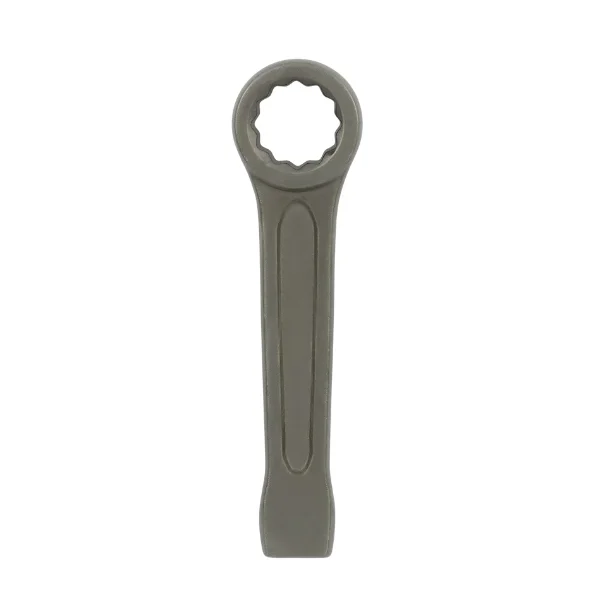
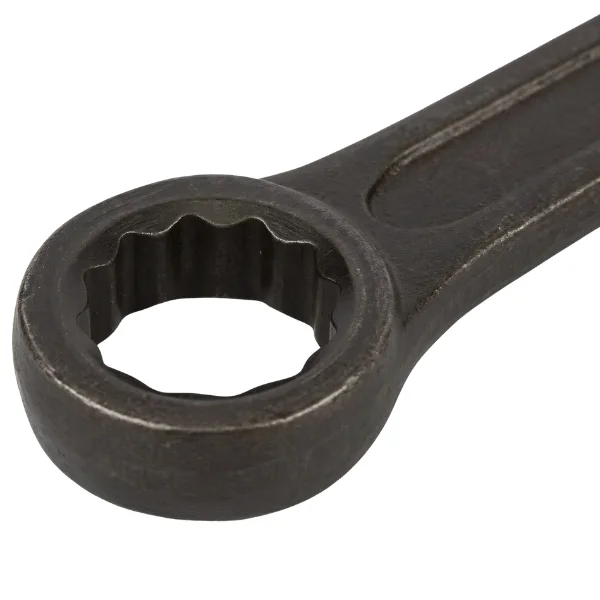
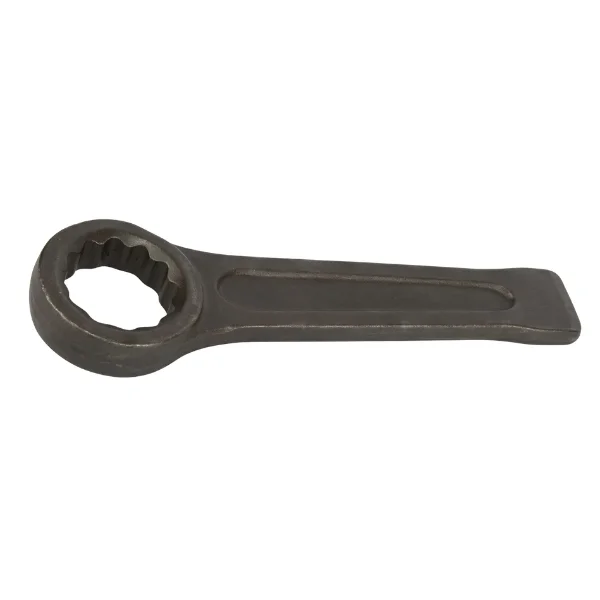
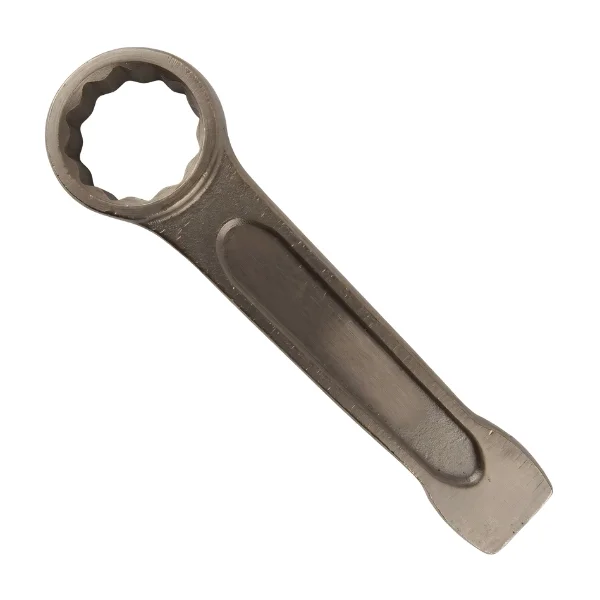


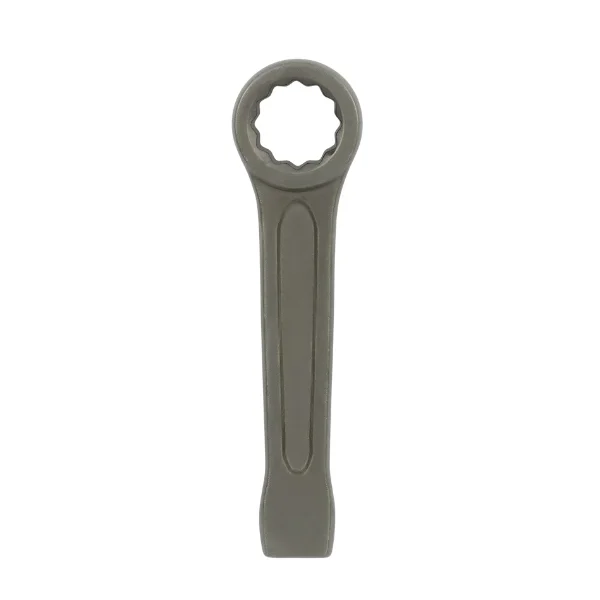
The closed ring end distributes force uniformly across the nut profile while the striking end allows controlled hammer blows for high-torque applications in steel plants, refineries, power plants, and heavy equipment maintenance.
Application Context & Use Cases
Large industrial fasteners often exceed the torque capacity of standard spanners. In such situations, a slogging spanner allows maintenance teams to apply controlled hammer impact to rotate the fastener.
Typical Industrial Applications
Shutdown Maintenance
Turbine casing bolt removal
Heat exchanger flange bolts
Pressure vessel fasteners
Heavy Equipment Assembly
Structural bolt tightening
Mining equipment assembly
Crane and rigging hardware installation
Industrial Repair Operations
Removal of seized fasteners
Over-torqued bolt release
Corrosion-affected bolt removal
Common Industry Environments
Industry |
Typical Usage |
|
Steel Plants |
Rolling mill bolt maintenance |
|
Oil & Gas |
Pipeline flange bolts |
|
Power Plants |
Turbine casing fasteners |
|
Cement Plants |
Kiln and crusher bolt assemblies |
|
Mining |
Excavator and structural equipment fasteners |
In these environments, controlled hammering allows operators to apply torque without hydraulic or powered torque tools.
Selection Guidance
Choosing the correct slogging spanner is critical for safe torque application.
Key Selection Factors
Correct Nut Size
The 85 mm ring size must match the exact hex dimension of the fastener. Oversized spanners cause rounding of the nut.
Fastener Accessibility
Slogging spanners require enough surrounding clearance for hammer swing.
Torque Requirement
Large industrial bolts often require torque beyond manual force. Hammer impact provides incremental rotational force.
Ring Profile Compatibility
A 12-point ring provides better alignment during repeated hammer impacts.
When an 85 mm Spanner Is Required
Typical fastener sizes requiring an 85 mm spanner include:
M56 structural bolts
Heavy flange bolts
Large industrial coupling fasteners
Exact requirements depend on the nut dimension rather than bolt diameter.
Capacity / Calculation Example
Understanding the mechanical advantage of a slogging spanner helps determine suitability.
Example Torque Scenario
A maintenance technician must loosen a flange bolt requiring approximately 2500 Nm torque.
Manual hand torque using a spanner alone may deliver only 400–600 Nm.
Hammer impact increases torque through impulse force.
Simplified Impact Logic
Torque generated can be approximated using:
Torque = Force × Lever Arm
Example:
Hammer strike force: 2000 N
Effective lever arm: 0.6 m
Result:
Approximate torque impulse = 1200 Nm
Multiple hammer strikes progressively loosen the fastener.
Failure Conditions & Misuse Risks
Slogging spanners are designed for hammer striking, but misuse can lead to tool damage or operator risk.
Common Failure Conditions
Incorrect Size
Using a slightly oversized spanner causes:
Nut rounding
Slippage
Sudden tool release
Excessive Hammer Force
Repeated uncontrolled hammering may damage the striking face.
Material Fatigue
Low-quality forged tools can crack under repeated impact.
Poor Bolt Condition
Heavily corroded fasteners may require penetrating oil or heating before removal.
Operational Safety Considerations
Operators should:
Wear impact gloves
Maintain stable footing
Ensure controlled hammer swing
Avoid striking at extreme angles
Material / Compatibility Table
Compatible Fastener Types
|
Fastener Type |
Compatibility |
|
Hex nuts |
Fully compatible |
|
Structural bolts |
Suitable |
|
Flange bolts |
Suitable |
|
Square nuts |
Not recommended |
Typical Material Compatibility
|
Fastener Material |
Suitability |
|
Carbon Steel Bolts |
Suitable |
|
Alloy Steel Fasteners |
Suitable |
|
Stainless Steel Fasteners |
Use controlled hammering |
|
Soft Brass Fasteners |
Not recommended |
Operational Handling & Installation Considerations
Proper handling improves safety and tool life.
Tool Positioning
The ring end must fully seat on the nut before impact.
Partial engagement may cause:
Nut deformation
Spanner slippage
Hammer Selection
Recommended hammer types:
Sledge hammer
Heavy engineering hammer
Hammer weight typically ranges between 2–5 kg depending on bolt size.
Controlled Impact Technique
Instead of continuous heavy blows:
Apply steady aligned strikes
Observe bolt movement
Reposition if necessary
This prevents excessive shock loading.
Commercial Clarity
Industrial buyers typically require clarity before sending RFQ.
Lead Time
Typical dispatch timeline depends on stock availability.
Standard dispatch window:
1–5 working days
Dispatch Capability
Supply available Pan-India to industrial locations including:
Manufacturing plants
EPC project sites
Maintenance contractors
Minimum Order Quantity (MOQ)
MOQ generally depends on procurement requirements.
Industrial buyers may procure:
Single units for replacement
Multiple units for tool room inventory
Customization Availability
Customization is generally not applicable for branded tools such as STANLEY.
However, procurement support can include:
Bulk quantity supply
Project tool kit supply
Compliance & Certification
Products are supplied according to manufacturer specifications.
Buyers requiring documentation may request:
Product identification confirmation
Specification reference
Tender Compatibility
For public sector and EPC procurement, buyers typically require:
Exact model reference
Brand specification compliance
The model number STMT96972 ensures clear tender specification alignment.
Procurement Process
To process an enquiry efficiently, buyers should provide the following information.
Information Required
Product model (STMT96972)
Quantity required
Delivery location
Required delivery timeline
Project or maintenance application (optional)
Enquiry Handling
Industrial procurement enquiries are typically handled through:
RFQ submission
Email enquiry
Direct procurement contact
Providing clear specifications helps reduce procurement delays.
Comparison Table
Slogging Spanner vs Alternative Tools
Feature |
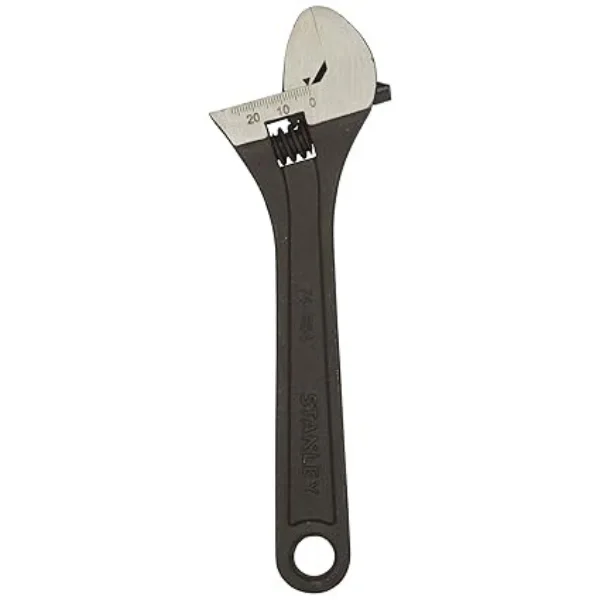
Slogging Spanner |
Adjustable Wrench |
Hydraulic Torque Wrench |
|
Torque Capacity |
High |
Low |
Very High |
|
Power Source |
Manual hammer impact |
Manual |
Hydraulic |
|
Industrial Use |
Heavy maintenance |
Light work |
Precision bolting |
|
Cost |
Moderate |
Low |
High |
|
Mobility |
Portable |
Portable |
Limited |
For large fasteners in industrial environments, slogging spanners remain a practical solution where powered torque tools are unavailable.
Selection Checklist
Before selecting the STANLEY 85 mm Slogging Spanner, confirm the following:
Fastener nut size is 85 mm
Adequate space exists for hammer swing
Application involves high-torque industrial fasteners
Operator is trained in hammer-impact tools
Controlled hammering can be performed safely
Fastener material can tolerate impact torque
If all conditions are satisfied, a slogging spanner is an effective manual torque tool.
High-Intent FAQs
What is the difference between a slogging spanner and a standard ring spanner?
A slogging spanner includes a reinforced striking end designed for hammer impact, allowing higher torque application for loosening large industrial fasteners.
Can the STANLEY STMT96972 spanner be used for tightening bolts?
Yes. While commonly used for loosening seized fasteners, it can also be used to tighten bolts where controlled hammer torque is required.
What hammer weight is suitable for an 85 mm slogging spanner?
Heavy engineering hammers between 2–5 kg are typically used depending on the required torque and fastener condition.
Is a slogging spanner safe for stainless steel fasteners?
It can be used, but operators must apply controlled hammer strikes to avoid galling or fastener damage.
How do I confirm the correct spanner size for my bolt?
Measure the nut hex dimension across flats. The spanner size must match this measurement precisely.
Can this tool replace hydraulic torque tools?
No. Slogging spanners are manual tools suited for heavy maintenance situations where powered torque equipment is unavailable or impractical.
Is the STANLEY STMT96972 suitable for refinery maintenance?
Yes. Slogging spanners are commonly used for flange bolts, structural fasteners, and shutdown maintenance tasks in refineries and similar heavy industrial environments.
Technical Specifications
Product Identification
Model Details
Parameter |
Specification |
|
Brand |
STANLEY |
|
Model Number |
STMT96972 |
|
Tool Type |
Ring-End Slogging Spanner |
|
Size |
85 mm |
|
End Type |
Closed Ring |
|
Striking Surface |
Hammer impact end |
|
Application |
Heavy industrial fastening |
Dimensional Characteristics
|
Parameter |
Value |
|
Nominal Spanner Size |
85 mm |
|
Ring Profile |
12-point ring |
|
Tool Length |
Approx. heavy-duty profile |
|
Ring Offset |
Standard industrial offset |
|
Handle Type |
Solid forged body |
Material & Construction
|
Property |
Description |
|
Manufacturing Method |
Drop forged |
|
Steel Type |
High strength alloy steel |
|
Hardening Process |
Heat treated |
|
Surface Finish |
Industrial corrosion-resistant finish |
|
Impact Resistance |
Designed for hammer striking |







Customer reviews