



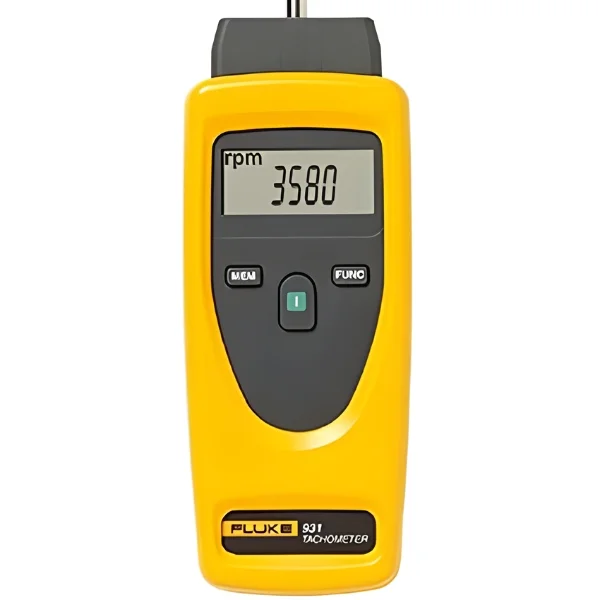


As a supplier and distributor, Indus Megamart ensures availability across India with procurement support for industrial buyers evaluating tachometers for field and workshop applications.
What is Fluke 931 Contact & Non-Contact Tachometer
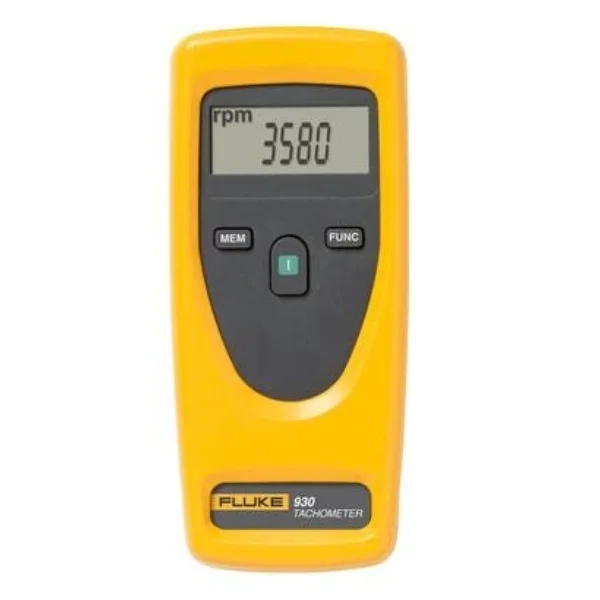
The Fluke 931 Contact & Non-Contact Tachometer is a handheld instrument used to measure rotational speed (RPM) of shafts, motors, and rotating components. It supports both contact measurement using a physical probe and non-contact measurement using optical sensing, allowing flexibility across different industrial maintenance and inspection scenarios.
In industrial environments, rotating equipment performance often needs to be verified without interrupting operations. The Fluke 931 Contact & Non-Contact Tachometer addresses this by offering two measurement approaches:
- Contact Mode: Used where direct access to the rotating shaft is possible. It provides stable readings for low-speed applications.
- Non-Contact Mode: Uses reflective markers and optical sensing, suitable for high-speed or inaccessible rotating parts.
This dual-mode capability makes the instrument relevant for both preventive maintenance and troubleshooting workflows, where access conditions and safety considerations vary significantly.
Applications of Fluke 931 Contact & Non-Contact Tachometer
- Electric Motor Speed Verification
Used during commissioning and maintenance to confirm motor RPM against design specifications, helping detect slippage or electrical imbalance. - Conveyor Belt System Monitoring
Ensures conveyor speed consistency in packaging or material handling systems where speed variations can affect output quality. - HVAC Fan and Blower Diagnostics
Helps maintenance teams evaluate airflow-related performance by measuring fan speed in air handling units and ventilation systems. - Rotating Machinery Inspection in Workshops
Used in repair facilities to verify the speed of refurbished motors, pumps, or gearboxes before redeployment. - Textile Machinery Synchronization Checks
Useful in industries where spindle or roller speed must be aligned to avoid material defects. - Pump and Compressor Performance Analysis
Assists in identifying deviations in rotational speed that may indicate mechanical wear or drive issues.
Industries Using Fluke 931 Contact & Non-Contact Tachometer
The Fluke 931 Contact & Non-Contact Tachometer is used across industries where rotating equipment performance directly impacts operations:
- Manufacturing plants with motor-driven systems
- HVAC and building maintenance services
- Textile and process industries
- Automotive service and repair workshops
- Power generation and utility maintenance teams
- Material handling and logistics facilities
Its portability and dual-mode functionality make it suitable for both field service engineers and in-house maintenance teams.
Operational Considerations
Selecting and using the Fluke 931 Contact & Non-Contact Tachometer requires understanding the operating environment:
- Surface Accessibility: Contact mode requires safe physical access to the rotating shaft
- Lighting Conditions: Optical mode may require stable lighting and proper reflective tape placement
- Safety Constraints: Non-contact mode is preferred for high-speed or hazardous equipment
- Equipment Type: Smooth shafts vs irregular surfaces influence measurement method
- Environmental Conditions: Dust or vibration can affect measurement accuracy in certain setups
Integration with maintenance workflows often includes use alongside vibration meters, clamp meters, and thermal cameras.
Customization Options
As a standard industrial instrument, the Fluke 931 Contact & Non-Contact Tachometer is typically supplied in predefined configurations. However, procurement flexibility may include:
- Selection of accessory kits (contact tips, reflective markers)
- Packaging options for field engineers
- Bundled supply with complementary test instruments
Indus Megamart supports buyers in selecting appropriate configurations based on application requirements.
Product Supply & Distribution Capability
Indus Megamart operates as a supplier and distributor of test and measurement instruments, including the Fluke 931 Contact & Non-Contact Tachometer.
- Sourcing from authorized supply channels
- Handling bulk and project-based procurement
- Supporting industrial buyers with documentation and product selection
- Coordinating dispatch based on urgency and project timelines
Learn more about the company’s operational background on the About Page:
https://www.indusmegamart.com/about-us
Supply Across India
Indus Megamart supports Pan India supply, ensuring availability of the Fluke 931 Contact & Non-Contact Tachometer across:
- Industrial zones
- Metro cities
- Remote project sites
Logistics coordination includes:
- Standard dispatch timelines
- Support for urgent requirements
- Coordination with project procurement schedules
Export Capability
For international buyers, Indus Megamart facilitates export supply of industrial instruments:
- Documentation support for export shipments
- Coordination with logistics partners
- Supply to contractors and international project buyers
Export availability may depend on product category and order volume.
How to Choose the Right Fluke 931 Contact & Non-Contact Tachometer
When evaluating this tachometer, procurement teams should consider:
- Measurement Mode Requirement
Whether both contact and non-contact modes are required for the application - Speed Range Compatibility
Alignment with expected RPM range of equipment - Access Conditions
Whether equipment allows physical contact or requires remote measurement - Work Environment
Indoor vs outdoor, dusty or clean environments - Integration with Maintenance Tools
Compatibility with existing diagnostic workflows - Operator Skill Level
Ease of use for technicians and field engineers
Comparison Table
The Fluke 931 Contact & Non-Contact Tachometer is often compared with single-mode tachometers. Below is a functional comparison:
Feature |
Dual Mode Tachometer (Fluke 931) |
Contact Only |
Non-Contact Only |
|
Measurement Flexibility |
High |
Limited |
Limited |
|
Safety in High-Speed Use |
High |
Low |
High |
|
Accuracy at Low Speed |
High |
High |
Moderate |
|
Accessibility Requirement |
Flexible |
Direct access needed |
Line-of-sight needed |
|
Typical Use Case |
Multi-environment maintenance |
Workshop use |
Field diagnostics |
Typical Use Case Scenarios
- Maintenance Team in Manufacturing Plant
Uses non-contact mode to check motor speeds without stopping production lines. - Field Service Engineer
Uses portable tachometer during on-site inspection of HVAC systems in commercial buildings. - Workshop Technician
Uses contact mode to validate repaired motor performance before dispatch. - Project Commissioning Engineer
Verifies rotating equipment speed alignment during installation of new systems.
Procurement Process
To procure the Fluke 931 Contact & Non-Contact Tachometer:
- Identify application requirements
- Confirm measurement mode and accessories
- Request quotation
- Evaluate delivery timelines
- Place order
For enquiries, visit:
https://www.indusmegamart.com/contact-us
Common Buyer Concerns Before Ordering
- Whether dual-mode functionality is necessary for their application
- Accuracy consistency between contact and non-contact modes
- Availability of accessories and replacement parts
- Delivery timelines for urgent projects
- Compatibility with existing maintenance tools
Indus Megamart addresses these concerns during the enquiry and pre-purchase discussion stage.
FAQs
How does the Fluke 931 Contact & Non-Contact Tachometer work?
It measures rotational speed either by physical contact using a probe or by detecting reflected light from a rotating surface. The non-contact method uses reflective tape, while contact mode directly touches the shaft to measure RPM.
When should I use contact vs non-contact mode?
Contact mode is suitable for low-speed or easily accessible shafts. Non-contact mode is preferred for high-speed, hazardous, or hard-to-reach rotating components where safety or accessibility is a concern.
Is the Fluke 931 suitable for field use?
Yes, its handheld design makes it suitable for both field and workshop environments. It is commonly used by maintenance engineers and service technicians for on-site inspections.
Can it be used for preventive maintenance?
Yes, tachometers like the Fluke 931 are widely used in preventive maintenance programs to detect deviations in rotational speed, which may indicate mechanical or electrical issues.
Does it require calibration?
Like most measurement instruments, periodic calibration is recommended to maintain accuracy, especially in critical industrial applications.
What accessories are typically required?
Common accessories include reflective tape for non-contact measurement and contact tips for different shaft types. Availability may vary based on supply configuration.
How does it compare with digital panel tachometers?
Portable tachometers like the Fluke 931 are used for spot measurements, whereas panel tachometers are fixed installations for continuous monitoring.
Request a Quote for Fluke 931 Contact & Non-Contact Tachometer
Indus Megamart supplies and distributes the Fluke 931 Contact & Non-Contact Tachometer for industrial buyers across India and export markets.
For pricing, availability, or technical clarification, contact the team via:
https://www.indusmegamart.com/contact-us
For procurement support, technical discussions, or bulk enquiries:
- Visit Contact Page: https://www.indusmegamart.com/contact-us
- Learn more about the company: https://www.indusmegamart.com/about-us
Indus Megamart supports procurement teams with product selection, availability checks, and supply coordination
For precise configuration details, buyers are advised to confirm specifications at the enquiry stage.
Product Specifications
Since exact configurations may vary, the following table outlines typical characteristics expected in this category:
Parameter |
General Description |
|
Measurement Type |
Contact and Non-contact (optical) |
|
Display |
Digital LCD display |
|
Measurement Units |
RPM (Revolutions Per Minute) |
|
Measurement Range |
Varies depending on mode and setup |
|
Sensing Method |
Optical sensor (non-contact), mechanical probe (contact) |
|
Power Source |
Battery-operated |
|
Portability |
Handheld, lightweight design |
|
Accessories |
Reflective tape, contact tips (varies by supply package) |







Customer reviews