



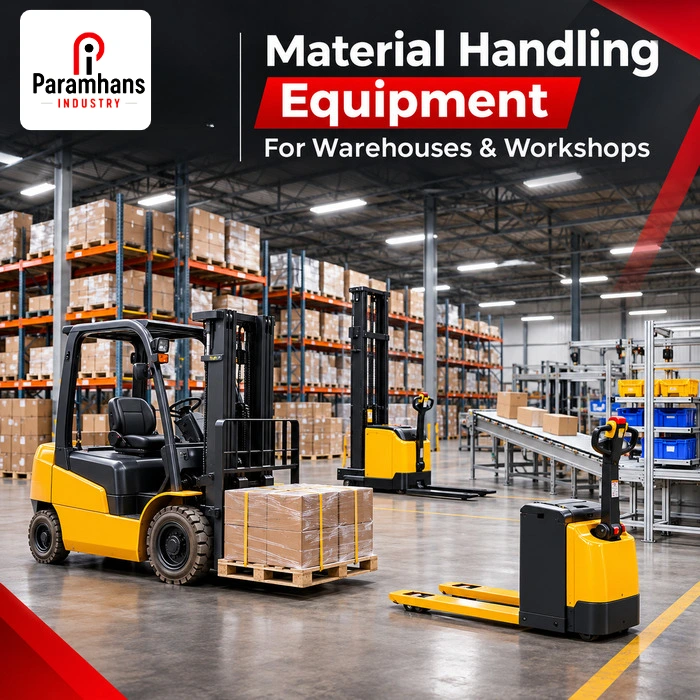
Material Handling Equipment for Warehouses and Workshops
Material handling equipment should shorten movement, reduce avoidable lifting and protect products without creating new collision, stability or maintenance risks. The right choice begins with the load, route, frequency, operator and working environment—not with a generic capacity label. A hand truck, platform trolley, pallet truck, stacker or lift table may each be appropriate for a different stage of the same workflow. This guide shows warehouse and workshop buyers how to map those duties, compare manual and powered options, verify practical constraints and prepare a purchase specification that suppliers can answer accurately.
Map the Material Flow Before Choosing Equipment
Walk the real path from receipt to storage, production, packing and dispatch. Record every pickup and set-down point, travel distance, turns, doorways, ramps, floor transitions, congestion point and lift interface. Separate routine moves from exceptions such as damaged pallets, returns and maintenance spares. This exposes repeated handling that layout changes may remove before equipment is purchased. For map the material flow before choosing equipment, record the operating assumption, the person responsible for verification, and the current product or site evidence used in the decision.
Indus MegaMart groups hand trucks, pallet trucks, stackers, dollies and lifting aids in its verified material handling equipment range. Use the range to identify possible equipment families, then test each family against the mapped journey. A product category is a discovery tool, not proof that one model fits every load or route. Treat an unresolved point about map the material flow before choosing equipment as an enquiry item with a due date; do not let a catalogue label or familiar brand replace a written duty and compatibility check.
Define the Load Beyond Its Weight
State normal and maximum weight, dimensions, centre of gravity, rigidity, base type, stackability, fragility and whether the load can shift. Note drums, sheets, long stock, irregular components and hot or contaminated items separately. A 300-kilogram compact crate behaves differently from a wide or tall load of the same mass, particularly on a turn, slope or uneven threshold. For define the load beyond its weight, record the operating assumption, the person responsible for verification, and the current product or site evidence used in the decision.
Confirm how the equipment contacts the load: forks, platform, toe plate, clamp, cradle or sling. Check pallet entry, fork pocket dimensions, underside clearance and load restraint. Never assume a nominal capacity covers every load position. Ask for the rated-capacity basis, load-centre conditions and derating information, and keep the intended load inside the manufacturer’s stated envelope. Treat an unresolved point about define the load beyond its weight as an enquiry item with a due date; do not let a catalogue label or familiar brand replace a written duty and compatibility check.
Choose the Equipment Family by Task
Use a two-wheel hand truck for suitable boxed loads and short vertical transfers; a platform trolley for mixed cartons or components; a pallet truck for horizontal pallet movement; a stacker for controlled lifting and stacking within its limits; and a lift table where adjustable working height reduces bending. Dollies can suit stable containers that need low-level movement. These are starting points, not universal rules. For choose the equipment family by task, record the operating assumption, the person responsible for verification, and the current product or site evidence used in the decision.
The verified Indus MegaMart sitemap lists multiple material-handling subcategories and named products, demonstrating why the enquiry must identify the task. Compare wheel layout, handle geometry, platform size, fork dimensions, lift range, turning radius and braking rather than treating all trolleys or trucks as interchangeable. Treat an unresolved point about choose the equipment family by task as an enquiry item with a due date; do not let a catalogue label or familiar brand replace a written duty and compatibility check.
Match Capacity to the Real Load Case
Select capacity with a reasoned margin for credible variation, but do not use a large headline rating to hide an unstable or poorly supported load. Capacity can depend on load centre, lift height, mast arrangement, platform distribution, slope and attachment. Ask the supplier to confirm the proposed model against the heaviest and most awkward defined case, not only average weight. For match capacity to the real load case, record the operating assumption, the person responsible for verification, and the current product or site evidence used in the decision.
Post visible limits on the equipment and include accessory weight where applicable. Prevent operators from extending forks, standing on platforms or adding improvised counterweights. If future loads are uncertain, define a controlled approval process rather than encouraging informal overloading. A higher-capacity machine can also be larger, harder to turn and more damaging in a collision. Treat an unresolved point about match capacity to the real load case as an enquiry item with a due date; do not let a catalogue label or familiar brand replace a written duty and compatibility check.
Check Aisles, Doors, Floors and Gradients
Measure clear aisle width at the narrowest operating condition, including stored goods, guards and columns. Record door width and height, dock plates, lift dimensions, turning areas, floor joints, drainage channels and gradients. Use the equipment’s overall dimensions and swept path with the actual load. A model that fits empty may not turn safely with a long pallet or protruding component. For check aisles, doors, floors and gradients, record the operating assumption, the person responsible for verification, and the current product or site evidence used in the decision.
Inspect floor load limits, flatness and condition. Small hard wheels may roll efficiently on smooth concrete but perform poorly at joints or debris. Larger resilient wheels can improve threshold travel but may change effort, stability and maintenance. Powered equipment needs additional review of traction, braking and safe stopping on gradients. Resolve damaged floors and route obstructions as part of the system. Treat an unresolved point about check aisles, doors, floors and gradients as an enquiry item with a due date; do not let a catalogue label or familiar brand replace a written duty and compatibility check.
Compare Manual, Semi-Electric and Powered Options
Manual equipment has simpler maintenance and can work well for lighter, shorter and less frequent moves. Semi-electric or powered lifting may reduce strenuous pumping or repeated elevation, while powered travel can support longer routes and higher throughput. The choice should use move frequency, distance, lift height, shift length, operator population, charging access and risk—not purchase price alone. For compare manual, semi-electric and powered options, record the operating assumption, the person responsible for verification, and the current product or site evidence used in the decision.
Powered equipment adds training, pedestrian interaction, battery, charger, inspection and emergency-response requirements. Manual equipment still creates crush, runaway and musculoskeletal risks. Observe a representative shift and estimate pushes, pulls, lifts and starts. A trial with the intended load is often more useful than a static showroom demonstration. Treat an unresolved point about compare manual, semi-electric and powered options as an enquiry item with a due date; do not let a catalogue label or familiar brand replace a written duty and compatibility check.
Evaluate Wheels, Castors and Brakes as a System
Wheel material, diameter, width, bearings and castor layout determine starting effort, rolling resistance, noise, floor marking and obstacle performance. Swivel castors improve manoeuvrability but can wander; fixed castors aid tracking. Compare configurations on the real floor with the full load. Ask whether wheels are suitable for oils, chemicals, metal chips, washdown, temperature and static-control needs. For evaluate wheels, castors and brakes as a system, record the operating assumption, the person responsible for verification, and the current product or site evidence used in the decision.
Brakes must match the hazard. A parking brake may prevent unattended movement but is not necessarily a service brake for ramps. Check activation force, accessibility and whether braking acts effectively with load. Define inspection and replacement limits for tyres, castors, axles and brake parts. One seized or worn wheel can sharply increase operator effort and destabilise the trolley. Treat an unresolved point about evaluate wheels, castors and brakes as a system as an enquiry item with a due date; do not let a catalogue label or familiar brand replace a written duty and compatibility check.
Build Ergonomics Into the Specification
Handle height, grip diameter, visibility, starting force, sustained push force, lift controls and loading height affect usability. Avoid designs that require twisting while pushing or place hands near pinch points. Where possible, push rather than pull and keep the route visible, but validate the method for the specific equipment. Adjustable-height aids can bring work into a better zone. For build ergonomics into the specification, record the operating assumption, the person responsible for verification, and the current product or site evidence used in the decision.
Ergonomic suitability varies by person, load, floor and frequency, so a capacity plate is not an ergonomic approval. Trial the proposed equipment with representative operators and a safe test load. Record effort, posture, visibility, control reach and task time. Involve safety and occupational-health specialists where risk assessment indicates a need. Treat an unresolved point about build ergonomics into the specification as an enquiry item with a due date; do not let a catalogue label or familiar brand replace a written duty and compatibility check.
Control Pedestrian, Pinch and Stability Risks
Separate vehicle and pedestrian routes where practical, mark crossings and keep fire routes clear. Review corners, blind doors, docks, ramps and staging areas. Guards, mirrors, speed controls, horns or warning lights may support the plan, but they do not replace clear routes and competent operation. Define right-of-way rules and supervision for mixed traffic. For control pedestrian, pinch and stability risks, record the operating assumption, the person responsible for verification, and the current product or site evidence used in the decision.
Check hand and foot clearance around wheels, forks, masts and set-down points. Loads should not block the operator’s view or exceed the stable footprint. Use restraints where movement could release contents. Never allow riding on equipment not designed for it, lifting people on load platforms or working under an unsupported raised load. Treat an unresolved point about control pedestrian, pinch and stability risks as an enquiry item with a due date; do not let a catalogue label or familiar brand replace a written duty and compatibility check.
Plan Inspection, Maintenance and Spare Support
Create pre-use checks for structure, welds, wheels, bearings, handles, forks, chains, hydraulics, controls, guards and brakes as applicable. Define defects that require immediate removal from service and provide a visible tagging method. Keep maintenance instructions and parts identification with the asset record rather than relying on memory or an untraceable online listing. For plan inspection, maintenance and spare support, record the operating assumption, the person responsible for verification, and the current product or site evidence used in the decision.
Review supplier support, spare lead time and the availability of common wear parts before purchase. The verified Indus MegaMart company page describes its distribution context; buyers should still confirm current model availability, warranty, service coverage and delivery for the site. Standardisation can simplify spares, provided it does not force unsuitable equipment into different duties. Treat an unresolved point about plan inspection, maintenance and spare support as an enquiry item with a due date; do not let a catalogue label or familiar brand replace a written duty and compatibility check.
Compare Total Operating Value, Not Unit Price
Include acquisition, freight, training, charging, inspections, wheels, batteries, hydraulic parts, downtime and expected service life. Add the value of reduced double handling, lower damage and faster flow, but avoid invented savings. Measure a current baseline and define how the trial will assess moves per hour, operator effort, incidents and product damage. For compare total operating value, not unit price, record the operating assumption, the person responsible for verification, and the current product or site evidence used in the decision.
Low-cost equipment that is hard to push, difficult to repair or regularly unavailable may cost more over its life. Conversely, automation or powered travel is not automatically justified for a short, occasional move. Use a consistent comparison period and state all assumptions. Retain a practical backup method for critical flows while equipment is serviced. Treat an unresolved point about compare total operating value, not unit price as an enquiry item with a due date; do not let a catalogue label or familiar brand replace a written duty and compatibility check.
Run a Controlled Trial and Acceptance Check
Trial the shortlisted model on the intended route with representative loads, trained people and agreed safety controls. Test pickup, travel, turning, stopping, set-down and parking. Include a credible maximum case without exceeding known limits. Record observations and confirm that the trial unit matches the final supplied specification, including wheels, battery and attachments. For run a controlled trial and acceptance check, record the operating assumption, the person responsible for verification, and the current product or site evidence used in the decision.
Use the comparison matrix below and the numbered procurement process to make the decision traceable. At delivery, inspect quantity, damage, labels, manuals, accessories and documented ratings. Complete training and asset registration before routine use. For the broader catalogue and company context, start at the verified Indus MegaMart website and request a model-specific quotation. Treat an unresolved point about run a controlled trial and acceptance check as an enquiry item with a due date; do not let a catalogue label or familiar brand replace a written duty and compatibility check.
| Decision area | Evidence to compare | Acceptance signal |
|---|---|---|
| Load | Weight, dimensions, centre and base | Inside documented rating |
| Route | Aisles, doors, turns, floor and slope | Controlled full-load trial |
| Operator | Force, posture, view and controls | Usable by representative team |
| Safety | Brakes, stability, clearances and rules | Risks controlled and trained |
| Support | Inspection, spares, warranty and service | Named process and availability |
1. Map the complete movement and eliminate avoidable handling.
2. Write the load, route and frequency specification.
3. Screen equipment families against the actual task.
4. Compare capacity, dimensions, wheels, brakes and ergonomics.
5. Trial shortlisted models with representative loads and operators.
6. Resolve safety, maintenance and commercial deviations in writing.
7. Inspect delivery, train users and establish a maintenance baseline.
Frequently Asked Questions
1. What equipment is used for warehouse material handling?
Common options include hand trucks, platform trolleys, dollies, pallet trucks, stackers and lift tables. The correct type depends on the load, route, lift and frequency.
2. How much capacity margin should a buyer allow?
Use a justified margin for credible variation and the manufacturer’s load-centre rules. An oversized rating does not correct poor stability or support.
3. Is a manual pallet truck suitable for every pallet?
No. Check pallet entry, fork dimensions, condition, weight, floor, slope and turning space before approval.
4. When is powered equipment worth considering?
Consider it for longer, more frequent or more demanding moves when a risk and lifecycle review supports power, charging, training and maintenance.
5. Which wheel material is best?
There is no universal choice. Match wheel material and size to floor condition, noise, chemicals, debris, load and starting effort.
6. Do trolley brakes make ramp use safe?
Not automatically. Confirm the brake type and rated gradient, and complete a route-specific risk assessment.
7. How should equipment be trialled?
Use the intended route, representative operators and realistic loads, then observe pickup, travel, turns, stopping, set-down and parking.
8. What should a pre-use check cover?
Check structure, welds, handles, wheels, forks, hydraulics, controls, guards and brakes as relevant, with clear removal-from-service criteria.
9. Can workers ride on material handling equipment?
Only equipment specifically designed and approved for riding should carry a person. Never improvise passenger use.
10. How is ergonomic suitability verified?
Observe representative people performing the real task and review force, posture, reach, visibility, frequency and duration.
11. What information belongs in a supplier enquiry?
Include load data, route, duty cycle, lift, environment, dimensions, required controls, documentation, warranty, spares and delivery.
12. How should buyers compare prices?
Compare total operating value, including maintenance, wear parts, energy, downtime, training, damage and service life—not only purchase cost.
Build a Safer, Faster Material Flow With Task-Matched Equipment
A strong purchase decision connects the actual load and route with stable, maintainable equipment that operators can control throughout the shift. For a model-specific comparison covering capacity, dimensions, wheels, lift range, current availability and commercial terms, contact the Indus MegaMart material-handling team through its verified enquiry page and attach your duty sheet and route measurements.