



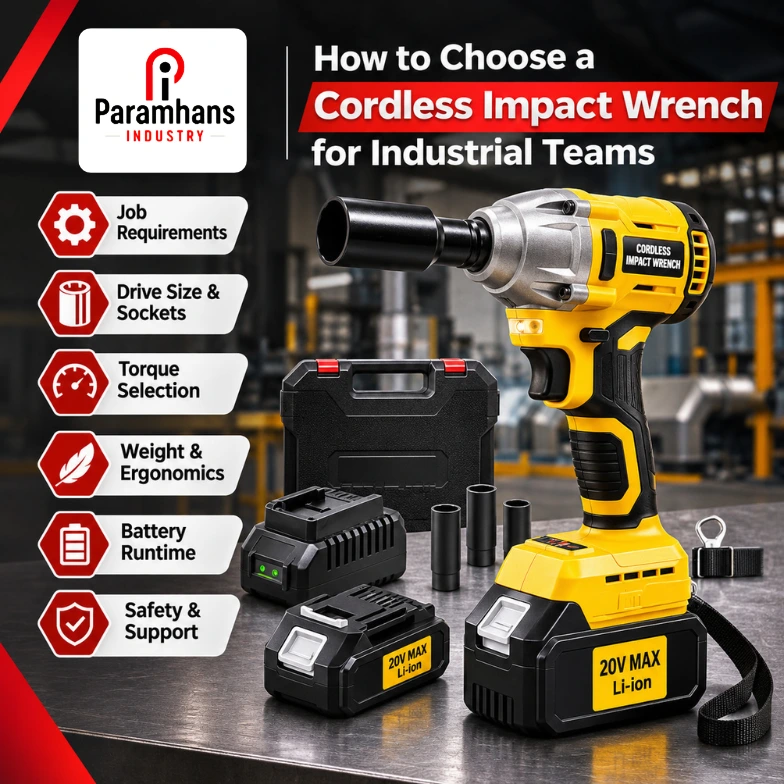
How to Choose a Cordless Impact Wrench for Industrial Teams
The best cordless impact wrench for an industrial team is the one that covers the verified fastening and removal duties with controllable output, compatible impact sockets, practical shift runtime and manageable operator load. Selection should connect the joint requirement, drive size, torque evidence, battery platform, access, safety and support. This guide gives maintenance, workshop and procurement teams a repeatable way to compare tools without treating one headline specification as the decision.
Start With the Fastening Jobs the Team Actually Performs
A cordless impact wrench should be chosen from the joint, access and production duty-not from the highest torque figure on a product card. List the fasteners the team installs and removes, their sizes and grades, the materials being joined, normal torque requirements, breakaway difficulty, corrosion exposure and available clearance. Separate controlled assembly from dismantling. A tool that removes rusted wheel nuts quickly may be too heavy or aggressive for repetitive brackets, covers and machine guards.
Record daily cycles, peak-shift use, indoor or outdoor work, travel between assets and whether the operator works overhead or inside machinery. Identify the sockets already standardised, the battery platform already used and any permit or spark-control restrictions. Indus MegaMart’s cordless impact wrench category shows compact and high-torque tools in different drive sizes; a team specification should narrow that range with application evidence before a model is purchased.
Distinguish Impact Wrenches From Impact Drivers and Torque Tools
An impact wrench usually accepts square-drive sockets and is intended for nuts and bolts. An impact driver commonly accepts hex bits and suits screws and smaller fasteners. The names are sometimes used loosely, so verify the actual anvil and rated duty. Neither tool should automatically be treated as a calibrated torque wrench. Impact output varies with battery state, joint stiffness, socket, lubrication, operator time and tool mode.
For safety-critical or specification-controlled joints, use the impact wrench for rundown or removal only, then complete tightening with the approved calibrated method. Define this boundary in the work instruction. The broader power-tools range is useful for comparing drilling, fastening and cordless categories, but procurement must match each task to the correct tool type rather than assuming one machine can replace every fastening device.
Size the Drive and Socket System as One Assembly
Square-drive size affects available socket range, bulk and suitability for fastener size. Compact 3/8-inch or 1/2-inch tools can improve access and reduce fatigue; larger 3/4-inch systems may suit heavier industrial joints. Do not choose by drive alone. Confirm that impact-rated sockets, extensions and retainers are available in the exact sizes needed. Chrome hand sockets are not a substitute for impact sockets and may fail under repeated blows.
Check the anvil style and retention method against the team’s socket-changing needs. Friction-ring systems can speed changes, while pin detents may retain accessories more securely in some conditions. Long extensions, universal joints and adapters absorb energy and can reduce effective output. Standardise the shortest approved accessory stack and include sockets in the budget, inspection plan and tool-control register.
Interpret Torque Figures Without Overbuying
Manufacturers may publish fastening torque, maximum torque and breakaway torque under defined test conditions. These values are not interchangeable and may not reproduce the same result on a dirty, lubricated, corroded or flexible joint. Select enough capacity for the verified application with sensible margin, but avoid excessive size. A high-output tool operated at full power can damage threads, stretch bolts or make a light-duty task harder to control.
Ask for the exact model datasheet and identify which value supports each job. Trial representative fasteners and confirm final torque separately where required. Use modes or speed settings as repeatability aids, not as substitutes for joint verification. If two teams share the tool, document approved settings for each task and prevent informal changes that undermine the work instruction.
Balance Power With Weight, Length and Ergonomics
A tool used for hundreds of cycles should be evaluated in its working position with the intended battery and socket attached. Compare total weight, head length, grip diameter, trigger control, forward–reverse access, vibration, balance and visibility. A compact tool that completes most jobs can improve access and reduce fatigue even if a larger model has more headline output.
Run a short task trial with representative operators and gloves. Observe wrist posture, reach, reaction to impacts and the need to support the tool during alignment. Consider belt hooks, lanyard points or tethering only when the manufacturer approves them. For elevated or confined work, include dropped-object and access controls. Ergonomic selection should be documented rather than inferred from bare-tool weight.
Choose the Battery Platform for Shift Coverage
Voltage does not by itself determine useful performance. Compare the complete tool, battery chemistry, ampere-hour capacity, current capability, charge time and thermal management. A larger battery may extend runtime but increases weight. Estimate cycles per charge from a representative trial and define the number of packs needed for the shift, travel between locations and charger access.
Platform compatibility can reduce chargers and spares, but it should not force an unsuitable tool. Verify that batteries and chargers are genuine, matched and supported. Provide a safe charging area away from heat, moisture and combustible clutter. Label batteries, inspect housings and terminals, and retire damaged packs through the approved process. The Indus MegaMart home catalogue can help buyers review adjacent tool families, while current stock and exact kit contents still need confirmation.
Specify Controls, Modes and Protective Features
Variable speed, multiple output modes, automatic stop or reverse-control functions can help reduce dropped nuts and overrun, but the behaviour differs by model. Verify what each mode does in the manual and trial it on the real joint. An LED work light, electronic brake and clear battery indicator may improve field usability. Brushless motors can reduce maintenance and improve efficiency, although the complete tool design still governs durability.
Define a default mode for every recurring job. Supervisors should confirm that operators understand forward and reverse selection, trigger control and the limits of automatic features. If a mode changes after battery removal or power cycling, include that in pre-use checks. Protective boots and guards should be approved for the model and must not block ventilation or labels.
Plan Safety, Training and Maintenance Before Issue
Complete a task risk assessment covering flying debris, pinch points, entanglement, noise, vibration, hot sockets, fastener failure and stored mechanical energy. Isolate equipment when required and use eye, hearing and other protection selected for the site. Operators should stabilise the workpiece, keep hands clear and stop if a socket, fastener or tool behaves abnormally.
Create pre-use checks for the anvil, retainer, housing, trigger, battery and impact socket. Clean ventilation openings and follow the manufacturer’s service limits. Track tool serial number, battery sets, inspection status and repair history. Review Indus MegaMart’s company information for supplier context, but base acceptance on the exact submitted model, warranty, authorised service arrangement and documentation.
Procure With a Written Team-Level Specification
Request the exact model code, drive, fastening and breakaway ratings, modes, dimensions, bare and equipped weight, batteries, charger, case, warranty, manuals and delivery scope. State the required sockets and accessories. Confirm whether the offer is a bare tool or kit; visually similar listings can contain different batteries or chargers. Require a deviation list rather than accepting a generic quotation.
Evaluate sample performance on representative joints, then approve one configuration. Indus MegaMart identifies itself as a supplier and distributor, so buyers should verify current product availability, lead time, logistics and after-sales support for the specific order. For bulk or project supply, send quantities, destination, application and required delivery dates instead of assuming every listed item is immediately available nationwide.
Test Representative Joints Before Fleet Purchase
A short controlled trial is more useful than comparing catalogue numbers in isolation. Select clean assembly joints, routine service fasteners and the most difficult removal cases. Use the proposed battery, impact socket and any approved extension. Record whether the tool seats easily, reaches the fastener, releases it within a reasonable time and gives the operator enough control to stop without damaging the joint. Include cold-start and low-battery conditions when they reflect real work.
Do not use the trial to invent a universal seconds-to-torque rule. Joint friction and stiffness vary too much. Instead, verify that the tool profile covers the intended work and define where a different method is required. Capture operator feedback on balance, trigger modulation, noise and access. A signed trial sheet creates evidence for approval and helps prevent a later purchase based only on one unusually easy demonstration.
Plan the Complete Socket and Accessory Set
The tool is productive only when the correct impact-rated sockets are available at the point of use. Build the set from actual fastener sizes, including deep sockets where studs project and thin-wall options only where their rating supports the duty. Identify approved adapters, extensions, retaining pins, rings and protective sleeves. Mixed brands can be acceptable when compatibility is documented, but uncontrolled combinations create fit and retention problems.
Store sockets so missing or damaged pieces are visible. Inspect drive corners, cracks, mushrooming and retention features, and remove defective items immediately. Mark dedicated sets for contaminated, stainless or sensitive service if cross-contamination matters. Include replacement frequency and responsible ownership in the tool-control plan. This avoids the common outcome in which a suitable wrench is undermined by worn, non-impact or improvised accessories.
Compare Warranty, Repair and Downtime Support
Industrial teams should evaluate what happens after a trigger, anvil, motor or charger fails. Confirm warranty duration and exclusions, proof-of-purchase requirements, authorised service location, expected assessment time and the availability of common parts. Ask whether batteries and chargers are covered separately. A long warranty has limited value when the tool must travel far or the exact model has no practical repair path.
Estimate the operational cost of downtime and decide whether a spare tool, spare charger or loan arrangement is needed. Standardising a small fleet can simplify training and parts, but concentration also creates a common-failure risk. Keep serial numbers and repair reports so recurring problems can be distinguished from misuse. Use lifecycle evidence when renewing the fleet instead of repeating the original purchase automatically.
Control Issuing, Storage and Shared-Team Use
Shared tools need a clear issue system. Assign each wrench, battery and charger an asset number and record the responsible team or user. Store them dry, secure and away from high heat, conductive debris and unauthorised modifications. Batteries should not be left loose with metal objects. Define the charge state for storage and rotation so the oldest packs are used and weak units are identified rather than quietly returned to the cabinet.
Post a concise task matrix beside the storage point: approved joints, mode, socket family, final-torque step and prohibited uses. Require defects to be tagged, not passed to the next shift. Supervisors should review missing accessories, battery condition and repair trends. These controls make a cordless platform predictable across several operators and help the organisation separate equipment limitations from training or housekeeping problems.
Review the Selection After Real Production Use
Set a review after several weeks or a defined number of cycles. Compare battery consumption, completed jobs, operator feedback, socket damage, repairs and any over-tightening or thread incidents with the assumptions used in selection. Observe whether teams bypass the approved final-torque step or add unauthorised adapters to reach difficult joints. Correct the work method or equipment set before the behaviour becomes normal practice.
Use the review to decide whether the fleet needs a compact companion tool, a higher-output specialist tool or different batteries. Update training and the task matrix when applications change. A cordless impact wrench should remain tied to a controlled duty; adding new fastener sizes, extensions or environments without review can invalidate the original safety and performance decision.
Estimate Lifecycle Cost Instead of Comparing Purchase Price
Compare the complete cost of tool, batteries, chargers, impact sockets, accessories, inspection, repairs and replacement packs over the expected service period. Include the productivity effect of battery changes, charging queues and tools that cannot release the target fastener. A cheaper kit can become expensive when its batteries age early or service turnaround leaves the team without equipment.
State the assumptions: daily cycles, number of operators, battery life, repair rate and evaluation period. Keep productivity claims conservative unless they are measured in the trial. Review total cost alongside ergonomic and safety evidence; the lowest lifecycle estimate should not win if it encourages an oversized tool or weak control of critical joints.
Set Clear Acceptance Criteria at Delivery
On receipt, match model codes, serial numbers, batteries, charger voltage, plugs, case and accessories to the approved order. Inspect for transport damage and verify manuals, warranty documents and authenticity indicators. Charge batteries according to instructions, test every tool in forward and reverse, and confirm that modes and lights operate before general issue.
Record a baseline under a representative no-load and fastening check without creating an unauthorised calibration claim. Photograph the kit and label each asset. Quarantine deviations until the supplier resolves them. A disciplined receiving check prevents bare tools, smaller batteries or incompatible chargers from entering service simply because the outer carton resembles the approved configuration.
Compare Three Useful Tool Profiles
| Profile | Best fit | Watch-outs |
|---|---|---|
| Compact 1/2-inch | Machine access, maintenance rounds, frequent moderate fasteners | May not release severe corrosion or large joints |
| Mid-torque 1/2-inch | Mixed workshop and field work with one common socket platform | Confirm weight and control on small fasteners |
| High-torque 3/4-inch | Large fasteners, heavy equipment and difficult removal | Higher mass, bulk and damage risk if misapplied |
A team may need two profiles rather than one oversized compromise. Keep final tightening controls separate whenever the joint specification requires verified torque.
Industrial Impact Wrench Selection Checklist
• List fastener sizes, grades, access and normal versus removal duties.
• Confirm square drive, impact-rated sockets and approved accessory stack.
• Compare fastening and breakaway ratings using exact-model evidence.
• Trial equipped weight, balance, vibration and reach with operators.
• Estimate cycles per shift and define batteries, chargers and spares.
• Approve modes, automatic features and task-specific default settings.
• Verify kit contents, warranty, authorised service and current delivery.
• Document safety, pre-use inspection, maintenance and final-torque method.
Frequently Asked Questions
1. Can an impact wrench replace a calibrated torque wrench?
Not automatically. Use it for rundown or removal, then apply the approved calibrated tightening method when the joint specification requires verified torque.
2. What drive size is best for industrial maintenance?
It depends on fastener range, access and available sockets. A 1/2-inch system suits many mixed duties, while larger joints may justify 3/4-inch equipment.
3. Is higher breakaway torque always better?
No. Extra output adds size, weight and damage risk. Select enough verified removal capacity for representative joints with reasonable margin.
4. What is the difference between fastening and breakaway torque?
Fastening torque describes tightening output under stated conditions; breakaway torque describes removal capability. Test methods vary, so use exact-model data.
5. Should the team buy a bare tool or a kit?
A kit can simplify deployment, but confirm batteries, capacities, charger, case and warranty. A bare tool may suit an established compatible battery platform.
6. How many batteries are needed?
Estimate from representative cycles, shift length, charge time and charger access. Include a controlled spare for critical work.
7. Can ordinary sockets be used?
Use impact-rated sockets and accessories approved for the drive and application. Hand sockets may not withstand repeated impacts.
8. Do extensions reduce performance?
They can absorb energy and increase movement. Use the shortest approved accessory stack and test difficult joints in the real configuration.
9. Are tool modes reliable for final torque?
They can improve control and consistency but are not a substitute for an approved torque-verification process.
10. What should be checked before every use?
Inspect housing, trigger, anvil, retainer, battery and socket; confirm the correct mode, direction and task isolation.
11. How should damaged batteries be handled?
Remove them from service, isolate safely and follow the manufacturer and site procedure for assessment, transport and disposal.
12. What information should go in a quotation request?
Exact duty, fasteners, drive, output evidence, kit contents, quantity, destination, warranty, service, delivery and required documentation.
Equip the Team for Faster Fastening Without Losing Control
A practical selection connects the real joint, equipped ergonomics, battery coverage, impact-rated accessories and a clear final-torque method. Share representative fastener sizes, removal conditions, shift cycles, preferred battery platform, quantities and destination through Indus MegaMart’s verified industrial-product support pageto confirm a suitable current model, kit contents, availability and delivery scope.